Arthritis on a Long Journey: Flights, Trains, and Everything in Between
Quick Answer: Stiffness comes from immobility, and joint tissue relies on movement to circulate the fluid that lubricates and nourishes it. On a long journey the problem is not the seat, it is the hours without movement. Move every 45 to 60 minutes even briefly, book seats that let you do it without asking anyone, dress for easy layering, and time medication around the journey rather than around the clock. Preparation before departure matters more than anything you can do once seated.
The flight is five hours. The stiffness will arrive somewhere around hour two, and by hour four standing up will be a whole event with an audience.

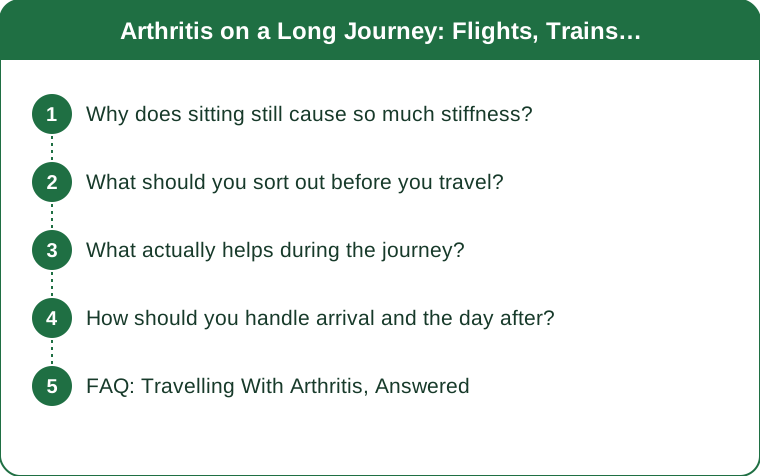
Why does sitting still cause so much stiffness?
Joint cartilage has no blood supply of its own and is nourished largely by the fluid inside the joint being moved around as the joint moves. Sustained immobility reduces that circulation, which is much of why stiffness builds during stillness and eases within minutes of moving.
Muscles shorten and tighten in a fixed position. Hip flexors, hamstrings, and calves all sit in a shortened position in a standard seat, and after several hours they resist lengthening - which is what makes standing up after a long flight feel dramatic.
Swelling accumulates in the lower legs. Sitting upright without calf muscle activity means the calf pump - the mechanism that helps return fluid upward - is switched off. That produces the familiar tight ankles and shoes that no longer fit, and swollen tissue around a stiff joint makes it feel worse.
Cabin conditions add their own layer. Aircraft cabins run at low humidity, which contributes to mild dehydration over a long flight, and lower cabin pressure is often reported to increase joint discomfort - though the evidence on pressure and joint pain is mixed and individual responses vary considerably.
And the day around the journey usually matters more than the journey itself. Carrying luggage, standing in queues, sleeping badly the night before, and a disrupted routine all stack, which is why the stiffness on arrival is frequently worse than the seated hours alone would explain.
What should you sort out before you travel?
Book the seat for movement, not for the view. An aisle seat on a plane means you can stand whenever you like without asking two people to move - which is the difference between moving six times and moving twice. On a train, a seat by a door area or a table with legroom serves the same purpose.
Request assistance if getting through an airport is genuinely difficult, and do it in advance. Airport assistance is free, and it is for anyone who needs it, not only wheelchair users. It removes the long walk and the standing queue, which are frequently the hardest parts of the whole journey.
Sort medication timing deliberately with your doctor or pharmacist before you go. Taking a dose so that it is working during the seated hours rather than wearing off mid-journey is a straightforward planning question. Across time zones, ask specifically how to handle the shift rather than improvising at the gate.
Keep all medication in hand luggage, in original labelled packaging, with a copy of the prescription for longer trips. Hold luggage goes missing and pharmacies abroad will want to know what they are looking at.
And do something the morning of travel. Ten minutes of gentle movement before leaving means you start the journey warm rather than starting it already stiff. Starting stiff is the version that is hardest to recover from.

What actually helps during the journey?
Move every 45 to 60 minutes, even for one minute. Set a timer rather than trusting yourself to notice. Standing, walking to the end of the carriage, or simply standing up in place is enough - it is frequency that matters here, not duration.
Do seated movements between the standing ones. Ankle circles, heel raises and toe raises, gentle knee extensions, shoulder rolls, and a slow neck turn each way. Ten repetitions of each, a few times an hour, keeps the calf pump working and prevents the worst of the stiffening.
Dress in easy layers with easy fastenings. Temperature swings between a warm terminal, a cold cabin, and a warm arrival are real, and cold joints stiffen faster. Choose layers you can manage seated and without fine finger work - a zip you can grip beats small buttons.
Support the joints that need it. A small cushion at the lower back, a rolled jumper under a knee, or a travel pillow used to keep the neck neutral rather than dropped. These are minor adjustments that change several hours.
Drink water steadily and go easy on alcohol. Dehydration worsens the general picture, and the trip to the toilet is a useful excuse to move anyway.
And use heat if you have it available. A disposable heat patch on a problem joint before boarding is genuinely useful, particularly for a cold cabin. Check airline rules for anything self-heating, and never use heat on an actively inflamed, hot, swollen joint - that is the situation where cold is more appropriate.
How should you handle arrival and the day after?
Expect the first hour after arriving to be the worst, and plan around it. Do not schedule anything demanding immediately after a long journey if you can avoid it. Walking slowly for ten minutes on arrival does more than sitting down does.
Move before you unpack. A short walk, a warm shower, and some gentle range-of-motion work resets far more effectively than lying down, even though lying down is what you will want.
Warmth helps at this point. A warm shower or bath eases stiffness, and it is one of the few interventions that is both effective and completely free of downside.
Anticipate a flare rather than being surprised by it. Many people find a long journey produces two to three days of increased symptoms. Keeping the first day light, staying hydrated, and continuing gentle movement shortens it - complete rest tends to lengthen it.
Keep the routine you have at home. If you do a morning mobility sequence, do it while travelling. The disruption of routine is a large part of why symptoms worsen on trips, and it is the most controllable part.
And speak to your team before a long or unusual trip. If you have inflammatory arthritis, are on immune-modifying medication, or are travelling somewhere with limited medical access, a conversation in advance covers vaccinations, medication storage, and what to do about a flare away from home. This is general information, not medical advice - your rheumatology team is the right source for your specific situation.
FAQ: Travelling With Arthritis, Answered
How do I reduce joint stiffness on a long flight?
Move every 45 to 60 minutes, even briefly, and set a timer rather than relying on noticing. Between standing breaks, do ankle circles, heel and toe raises, and shoulder rolls. Book an aisle seat so standing does not require anyone else to move, and start the day with gentle movement so you board warm rather than stiff.
Does flying make arthritis worse?
Prolonged immobility reliably increases stiffness, and low cabin humidity contributes to mild dehydration. Some people report that lower cabin pressure worsens joint pain, though evidence on pressure specifically is mixed. The queues, luggage handling, and disrupted routine around a flight often contribute as much as the flight itself.
Should I request airport assistance if I have arthritis?
Yes, if walking long distances or standing in queues is difficult. It is free, available to anyone who needs it, and not limited to wheelchair users. Book it in advance with the airline - it removes what is often the hardest part of the journey.
How do I manage arthritis medication across time zones?
Ask your doctor or pharmacist before you travel rather than improvising - the right approach depends on the medication. Keep everything in hand luggage in original labelled packaging with a copy of the prescription, since hold luggage can go astray and pharmacies abroad will need to identify what you take.
TL;DR:
- Stiffness comes from immobility - joint cartilage depends on movement to circulate the fluid that nourishes it.
- Move every 45 to 60 minutes with a timer; frequency matters more than duration.
- Book an aisle or door-area seat so standing never requires asking anyone to move.
- Request airport assistance in advance if walking or queueing is hard - it is free and not limited to wheelchair users.
- Sort medication timing with your doctor before you go, and keep it in hand luggage in labelled packaging.
- Do ten minutes of gentle movement the morning of travel so you start warm rather than already stiff.
- Expect two to three days of increased symptoms afterwards; gentle movement shortens it, complete rest lengthens it.
The journey is mostly won before you board. This is general information, not medical advice.
Keep Reading
This article is for general informational purposes only and is not medical advice. Always consult a qualified health professional for guidance specific to you.