Why Arthritis Pain Spikes in the First Cold Weeks — and What Helps
Quick Answer: Cold-weather joint pain has several contributors: reduced activity as outdoor movement drops, increased muscle tension from bracing against cold, barometric pressure changes which many people report as a trigger, and stiffer soft tissue at lower temperatures. Activity is the most modifiable and the most effective. Movement, warmth applied before activity rather than after, and maintaining strength through the season help most. This is general information, not medical advice — see your doctor about a persistent change in symptoms.
The first cold fortnight is predictable. Hands stiffer in the morning, knees complaining on stairs, and the sense that the whole winter is going to be like this.
It is worth separating what is happening. Some of it is the weather, and a substantial share of it is what the weather changes about your week — and that second part is where the leverage is.
Four factors, and what each one actually responds to.

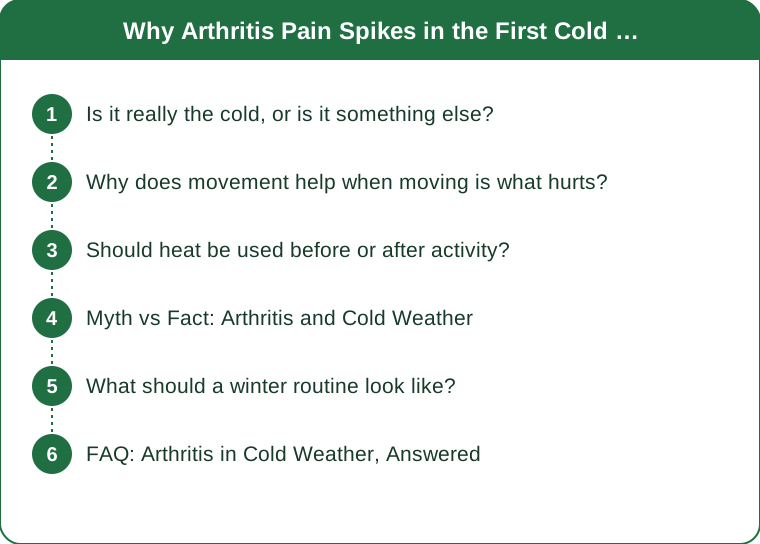
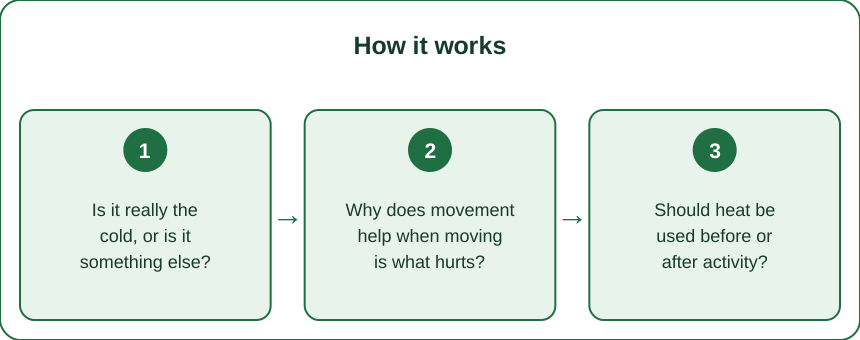
Is it really the cold, or is it something else?
The honest answer is that it is partly the cold and partly everything that arrives with it.
The research on weather and joint pain is genuinely mixed. Some studies find associations with temperature, humidity or barometric pressure; others find little. What is not in question is that a very large number of people consistently report the connection, and that experience deserves to be taken seriously rather than explained away.
What is much clearer is the activity effect. Outdoor walking, gardening and general daily movement drop substantially in autumn, and reduced movement reliably increases joint stiffness and pain in osteoarthritis. This is well established and it is the largest modifiable factor.
Muscle tension is a second contributor. Being cold produces bracing — shoulders up, jaw tight, grip tighter on everything. Sustained muscle tension around a joint increases load through it and produces its own pain.
Vitamin D falls through winter at northern latitudes, and low vitamin D is associated with musculoskeletal pain, though the relationship is complex. Supplementation is widely recommended over winter in these regions; ask your doctor or pharmacist about it.
The practical takeaway: you cannot change the pressure system, and you can change three of the four.
Why does movement help when moving is what hurts?
Because joints are maintained by motion, and the relationship between activity and pain is not linear.
Synovial fluid, which lubricates and nourishes joint cartilage, is circulated by movement. A joint that is not moved is a joint that is less well lubricated, which is a large part of why stiffness is worst after long stillness — mornings, and after an evening in a chair.
Muscle strength around a joint reduces load through it. Strong quadriceps meaningfully reduce knee pain in osteoarthritis, and this is one of the better-supported non-drug interventions there is. Losing strength over a sedentary winter tends to make the following spring worse than the one before.
The rule that makes this workable is to judge activity by how you feel the next day, not during. Some discomfort during movement is expected and acceptable. Pain that is clearly worse 24 hours later means the dose was too high — reduce it, but do not stop.
Little and often beats occasional and long. Five short movement breaks through a day do more for stiffness than one 40-minute session followed by eight hours in a chair.
Should heat be used before or after activity?
Before, for stiffness — and this is the point most people have backwards.
Heat applied before movement increases tissue extensibility and reduces the stiffness that makes starting difficult. A warm shower, a heat pack, or warm water for hands, ten to fifteen minutes before you intend to move, makes the movement itself considerably easier.
Cold is generally more useful for an acutely inflamed, swollen, hot joint — which is a different situation, and more characteristic of an inflammatory flare than of everyday osteoarthritic stiffness.
For hands specifically, warm water is the most effective and least appreciated intervention available. A bowl of warm water, or simply doing the washing up, before morning hand exercises transforms how they feel.
Practical cautions: do not apply heat to numb skin or skin with reduced sensation, avoid falling asleep on a heat pack, and keep temperatures comfortably warm rather than hot. If you have reduced circulation or neuropathy, ask a healthcare professional before using heat therapy at all.
Keeping the joints warm through the day matters too — thermal gloves, layers over knees, and simply keeping the house warm enough. A cold joint is a stiff joint, and staying ahead of it is easier than recovering it.

Myth vs Fact: Arthritis and Cold Weather
Myth: Cold weather causes arthritis. Fact: It does not cause it. It is associated with worse symptoms in many people, which is a different claim. Moving to a warm climate does not cure arthritis, though some people do report fewer symptomatic days.
Myth: If it hurts, you should rest it. Fact: For osteoarthritis, prolonged rest generally makes stiffness and pain worse over time. The evidence supports staying active with adapted movement. Acute flares are different and may need short-term rest — that distinction is worth discussing with a physiotherapist.
Myth: Exercise wears the joint out faster. Fact: Appropriate exercise does not accelerate joint damage and is one of the most strongly recommended management strategies in every major clinical guideline. High-impact, unaccustomed loading is a different matter from regular moderate activity.
Myth: Cracking joints in the cold means damage. Fact: Painless clicking and cracking are generally harmless and become more noticeable when tissues are cold and stiff. Clicking accompanied by pain, swelling or locking is worth getting assessed.
Myth: Supplements like glucosamine will fix it. Fact: The evidence is weak and inconsistent, and major guidelines generally do not recommend them. They are unlikely to harm most people, and they are not a substitute for exercise and weight management. Discuss with a pharmacist, especially if you take other medication.
What should a winter routine look like?
Simple, frequent, and built to survive the days when you do not feel like it.
Morning: warmth, then movement. Warm shower or warm water for hands, then five to ten minutes of gentle range-of-motion work before you do anything demanding. This is the highest-return ten minutes of the day for morning stiffness.
Through the day: break up sitting. Stand and move for two minutes every 30 to 45 minutes. Set a reminder if needed — the interval matters more than what you do in it.
Two to three times a week: strength work. Sit-to-stands, wall press-ups, resistance band work, or a supervised programme. This is what protects the joint, and it is the part most likely to be dropped in winter. A physiotherapist can build a specific programme in one or two appointments and it is the best-value professional input available.
Indoor cardiovascular options for the bad-weather days: stationary cycling, indoor walking, and warm-water pool sessions, which many people with arthritis find the most comfortable form of exercise available.
Watch weight and sleep, both of which drift in winter and both of which affect pain meaningfully.
And speak to your doctor if symptoms change substantially, if a joint becomes hot, swollen and red, if pain wakes you at night, or if your current management is no longer controlling things. A seasonal worsening is common; a persistent change deserves review. This is general information, not medical advice.
FAQ: Arthritis in Cold Weather, Answered
Do compression gloves and sleeves help?
Many people report benefit, particularly for hand stiffness overnight, and they are low-risk. The evidence is limited but the intervention is inexpensive and easy to trial for a fortnight.
Should I take pain relief before activity or after?
This depends entirely on what you take and why, and it is a question for your doctor or pharmacist rather than a general article. There are meaningful differences between medications in how they should be timed.
Is it worth tracking symptoms against the weather?
It can be, mostly because it identifies your own pattern rather than a general one. A simple daily note of pain out of ten plus the temperature, kept for a season, is far more useful for planning than any general rule.
TL;DR:
- Cold-weather worsening is partly weather and largely reduced activity, muscle tension and lost strength.
- Movement is the most modifiable factor — judge it by how you feel the next day, not during.
- Apply heat before activity for stiffness; cold is for acutely hot, swollen joints.
- Warm water for hands before morning exercises is the most underrated intervention there is.
- Keep two to three strength sessions a week through winter; this is what protects the joint.
- See a doctor for a hot swollen joint, night pain, or a persistent change — this is general information, not medical advice.
The first cold fortnight is genuinely harder. Most of what makes the rest of the winter harder is what quietly stops happening during it.
Keep Reading
This article is for general informational purposes only and is not medical advice. Always consult a qualified health professional for guidance specific to you.