How to Adjust a Walking Routine When Mornings Turn Cool With Arthritis
Quick Answer: Cooler mornings lengthen the time it takes for joints to loosen, so the first ten minutes of a September walk feel disproportionately worse than the same walk in August. Three adjustments cover most of it: warm up indoors before you go out rather than using the first block as the warm-up, shift the walk 60 to 90 minutes later so you are moving on a body that has already been up and about, and split a long walk into two shorter ones. Reducing distance is rarely the right first move.
The route did not get longer. Your first ten minutes just got harder, and if you judge the whole walk by them you will start cutting the wrong thing.

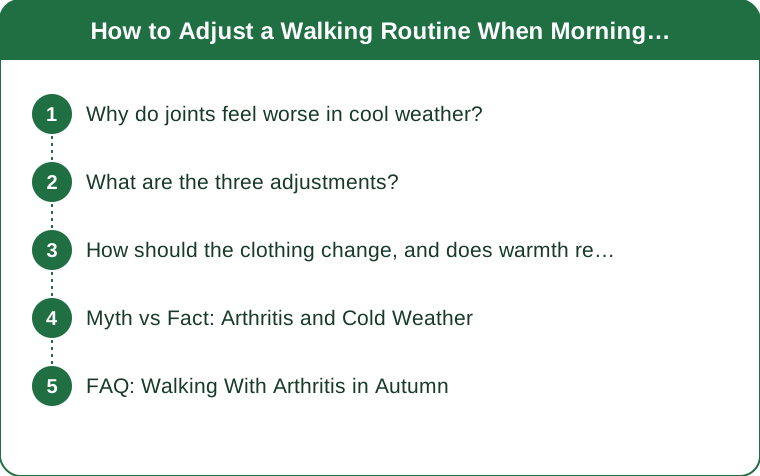
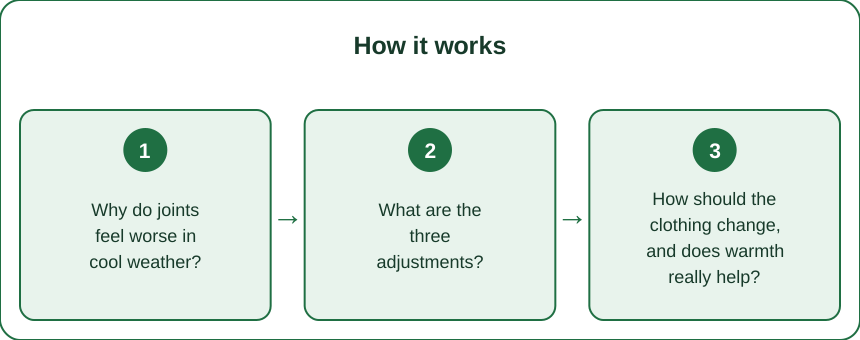
Why do joints feel worse in cool weather?
The honest answer is that the mechanism is not fully established, and anybody claiming certainty is overreaching. Studies looking for a link between weather and joint pain have produced mixed results, with some finding modest associations with temperature, humidity, or barometric pressure and others finding none.
What is better established is the stiffness side. Morning stiffness is a well-recognised feature of most arthritis, and cooler ambient temperature increases the time and movement needed before tissues become compliant. Whatever the pain mechanism, the loosening-up period genuinely lengthens.
Behaviour changes too, and it is easy to overlook. People move less on cool damp mornings - shorter strides, more guarded posture, more time sitting before going out. Reduced movement itself increases stiffness, which creates a loop that looks like weather causing pain when part of it is weather causing stillness.
Muscle temperature is the part you can directly control. Cold muscle is less compliant and produces more of the tight, braced feeling around a joint that gets read as joint pain. Ten minutes of indoor movement raises muscle temperature measurably, and this is where most of the practical benefit comes from.
The takeaway is not that the weather is imaginary. It is that the parts you can influence - preparation time, timing, and pacing - are large enough to change the experience substantially, even if the barometric pressure is not negotiable.
What are the three adjustments?
One: warm up indoors, before the door. Eight to ten minutes of gentle movement in a warm room - marching on the spot, sit-to-stands from a chair, ankle circles, arm swings, gentle knee bends. The goal is warmth and range, not effort. This replaces the first block of the walk being the warm-up, which is the version that hurts.
Two: move the walk later. Morning stiffness is typically at its worst on waking and improves over the following hour or two. A walk at 9:30 on a body that has been up since 7:00 is a fundamentally different proposition from a walk at 7:15. If the schedule allows only an early walk, extend the indoor warm-up rather than accepting the stiffness.
Three: split the distance. Two twenty-minute walks are often far more comfortable than one forty-minute walk, because the second one starts on a body that is already warm and loose. Total volume is preserved, which matters - reducing total walking is the change most likely to make things worse over a month.
A fourth if you need it: change the surface. Firm even ground is easier on painful knees and hips than uneven or cambered surfaces, and a flat park path in September beats a wet leaf-covered pavement on both comfort and safety.
What not to do first: stop walking. Regular moderate physical activity is one of the better-supported interventions for arthritis symptoms and function. The instinct to rest through a bad fortnight tends to produce a worse month, because deconditioning arrives faster than most people expect.

How should the clothing change, and does warmth really help?
Layering the joints specifically is worth more than layering generally. Knees and hands are the areas most people notice, and they are also the areas with the least surrounding muscle mass to generate heat. A pair of long trousers instead of shorts and a pair of light gloves address more discomfort than a heavier coat does.
Warmth before activity has reasonable support as a symptom management strategy - heat application is a common recommendation for stiffness, and a warm shower before an early walk is the simplest form of it. Whether it does anything structural is beside the point if it makes the first ten minutes tolerable.
Compression sleeves help some people and not others, and the evidence is mixed. They are cheap to try, and the plausible mechanisms are warmth and proprioceptive feedback rather than any structural support. If a knee sleeve makes you walk more, that is a real benefit.
Footwear deserves an autumn check. Summer shoes are often more worn than you think by September, and cushioning degrades gradually enough that it is invisible. Worn midsoles change loading at the knee and hip, and this is a very common unrecognised contributor to a bad autumn.
And watch the wet leaves. This is not a comfort issue, it is a fall risk, and it is the single most consequential seasonal hazard for anyone with reduced joint confidence. Route around them, and prefer paths that are cleared.
Myth vs Fact: Arthritis and Cold Weather
Myth: cold weather causes arthritis. Fact: it does not cause the condition. Studies on whether it worsens symptoms are genuinely mixed, with some finding modest associations and others none. What is consistent is that stiffness takes longer to resolve in cooler conditions, which is a real and manageable problem.
Myth: you should rest when joints hurt more. Fact: prolonged rest generally worsens stiffness and reduces function over weeks. Reducing intensity while maintaining frequency is the better response - short, more frequent, gentler walks rather than fewer or none.
Myth: walking wears joints out faster. Fact: moderate regular walking is associated with better outcomes in knee osteoarthritis, not worse. Cartilage responds to loading, and inactivity is a stronger risk factor for progression than reasonable activity.
Myth: if it hurts, you are damaging something. Fact: in chronic arthritis, pain level and structural damage correlate poorly. Mild to moderate discomfort during activity that settles within a day is generally acceptable, while pain that increases over hours after a walk or persists into the next day is the signal to reduce - but that is about dosing, not damage.
Myth: there is nothing you can do about the seasonal dip. Fact, and this is the practical heart of it: the three biggest levers - warm-up duration, time of day, and session splitting - are all fully within your control and together handle most of the September change. This is general information, not medical advice, and a significant or persistent change in your symptoms warrants a conversation with your doctor or physiotherapist.
FAQ: Walking With Arthritis in Autumn
Why does arthritis feel worse when the weather gets cold?
Research on the link is mixed, but morning stiffness reliably takes longer to resolve in cooler conditions, and people also move less on cold damp mornings, which increases stiffness further. Whatever the underlying mechanism, the practical effect concentrates in the first ten to fifteen minutes of movement.
Should I still walk every day with arthritis in cold weather?
Yes, in most cases. Regular moderate activity is one of the better-supported approaches for arthritis symptoms and function. Adjust the timing, the warm-up, and the session length rather than the frequency, and check with your doctor about your specific situation.
How long should I warm up before walking with arthritis?
Eight to ten minutes of gentle indoor movement in a warm room, and longer if you walk first thing in the morning. Sit-to-stands, marching on the spot, and gentle knee bends are enough - the aim is warmth and range of motion, not effort.
Is it better to do one long walk or two short ones?
Two short walks are usually more comfortable with arthritis, because the second starts on an already-warm body and neither session accumulates enough fatigue for form to deteriorate. Total daily volume matters more than how it is divided, so splitting preserves the benefit while reducing the discomfort.
TL;DR:
- Cooler mornings mainly lengthen the loosening-up period, so the first ten minutes get much harder while the rest of the walk stays the same.
- Warm up indoors for eight to ten minutes before you go out, instead of letting the first block of the walk be the warm-up.
- Shift the walk 60 to 90 minutes later - morning stiffness improves substantially over the first hour or two after waking.
- Split a long walk into two shorter ones to preserve total volume while removing the hardest part.
- Layer the joints specifically, check your summer shoes for worn cushioning, and route around wet leaves.
- Reduce intensity before you reduce frequency; stopping altogether tends to make the following month worse.
The walk is not too long. The start of it just needs ten minutes of preparation it did not need in August.
Keep Reading
This article is for general informational purposes only and is not medical advice. Always consult a qualified health professional for guidance specific to you.