How to Adjust Your Arthritis Exercise Routine When It's Cold Out
Quick Answer: Extend your warm-up to 10-15 minutes in cold weather (double the usual), keep joints covered and warm during exercise, and expect to need a slightly reduced range of motion in the first 10 minutes — that’s normal cold-joint behavior, not a sign to stop.
Your joints feel noticeably stiffer the moment the temperature drops, and it’s tempting to skip exercise on the coldest days entirely. The better move is usually adjusting the routine, not abandoning it — inactivity tends to make cold-weather stiffness worse, not better.

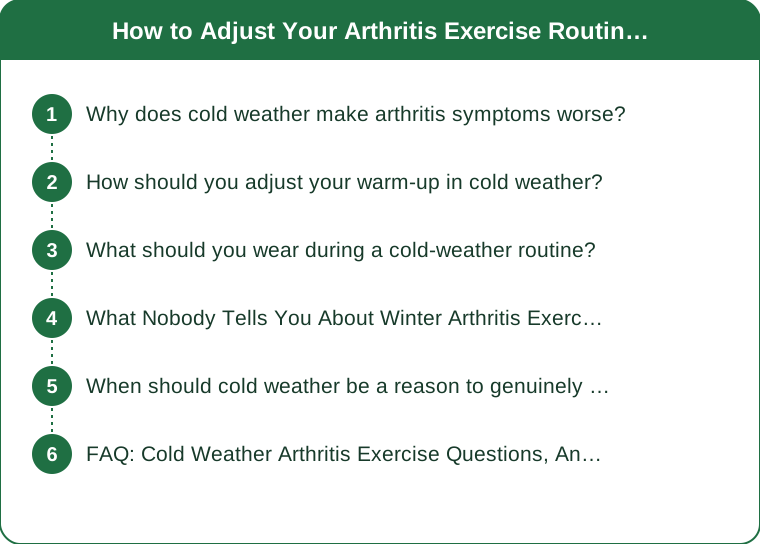
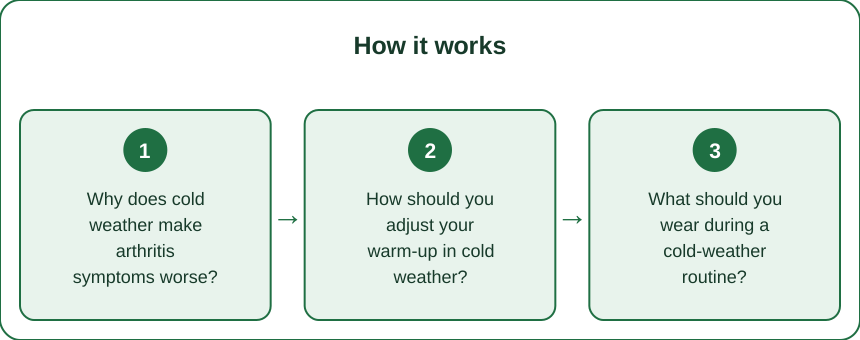
Why does cold weather make arthritis symptoms worse?
Cold temperatures can cause synovial fluid (the fluid that lubricates joints) to thicken slightly, and blood vessels constrict in response to cold, reducing blood flow to joint tissue. Both effects combine to make joints feel stiffer and less mobile than they do in warmer conditions — a real physiological response, not just perception.
How should you adjust your warm-up in cold weather?
Double your usual warm-up time — if you normally do 5 minutes, do 10-15 in cold conditions. Start with the smallest joints (fingers, wrists, ankles) doing gentle circles before moving to larger joint movements, since smaller joints often feel the cold-stiffness effect first and most intensely.
What should you wear during a cold-weather routine?
Layer over the specific joints affected — arthritis-friendly compression sleeves for knees or wrists, worn under regular layers, can maintain localized warmth throughout the session better than general clothing alone. Keeping hands and feet warm matters disproportionately, since extremities lose heat fastest and often show stiffness first.

What Nobody Tells You About Winter Arthritis Exercise
A slightly reduced range of motion in the first 10-15 minutes of a cold-weather session is normal, not a sign you should stop or that your condition is worsening. Range typically improves as the extended warm-up does its job — the key is not judging your session’s success by how the first few minutes feel.
When should cold weather be a reason to genuinely modify or skip exercise?
Sharp, new pain (different from usual stiffness), swelling that appears cold-weather specific, or joints that don’t loosen at all even after a full extended warm-up are reasons to scale back that session and check in with a provider — this is general information, not medical advice, and persistent new symptoms deserve professional evaluation rather than routine adjustment alone.
FAQ: Cold Weather Arthritis Exercise Questions, Answered
Is indoor exercise better than outdoor in winter for arthritis?
Generally yes — consistent indoor temperature avoids the cold-exposure stiffness entirely, though outdoor exercise with proper layering is still fine for those who prefer it.
Does hydration matter more in cold weather for joints?
Yes — people often drink less water when it’s cold, but joint tissue still needs hydration for the same lubrication function regardless of season.
How long does cold-weather stiffness typically last into a session?
With an adequate extended warm-up, most people notice meaningful loosening within 10-15 minutes — if stiffness persists well beyond that, it’s worth mentioning to your provider.
TL;DR:
- Double your warm-up time in cold weather — 10-15 minutes instead of 5
- Layer warmth over specific affected joints, not just general clothing
- A stiffer start is normal in cold conditions and should ease with warm-up
- New sharp pain or swelling that doesn’t ease is a reason to check with a provider. This is general information, not medical advice.
Keep Reading
This article is for general informational purposes only and is not medical advice. Always consult a qualified health professional for guidance specific to you.