Why the First Cold Week Hurts More — and What to Do in It
Quick Answer: The first cold week hurts because you move less, your tissues are cooler and stiffer, barometric pressure swings, and you’ve suddenly stopped the incidental walking that summer built in. The instinct is to rest, and resting is what turns a bad week into a bad season. Keep moving at reduced intensity, warm up longer than feels necessary, and rebuild the walking you lost — indoors if you have to.
Every year it’s the same conversation. The weather turns, everything aches, and someone says they must be getting old.
They’re not. Several things changed at once in the same week, and most of them are addressable.

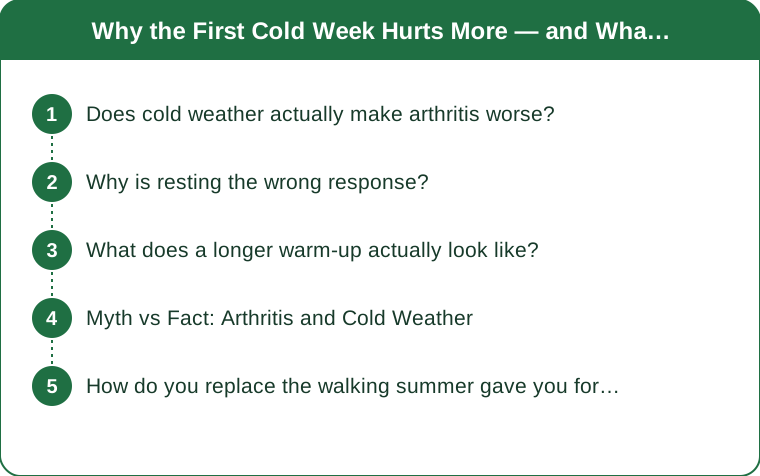
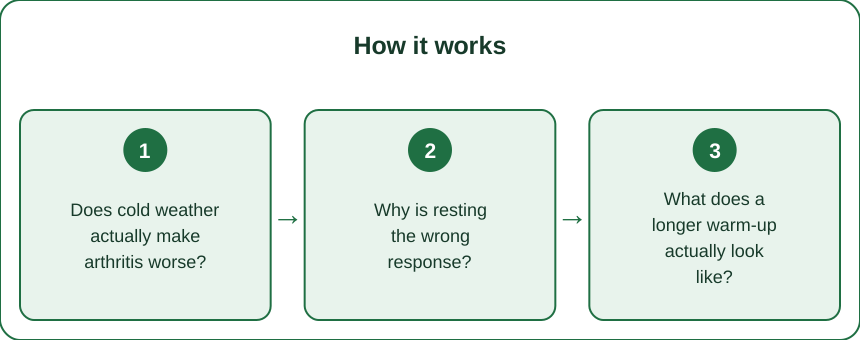
Does cold weather actually make arthritis worse?
Partly, and the honest answer is more complicated than either side of the argument suggests.
The research on weather and joint pain is genuinely mixed. Large studies have found small or inconsistent associations between temperature and reported pain, which is why some clinicians say weather doesn’t matter. Meanwhile, an enormous number of people report a real and reproducible pattern.
What’s better supported than temperature alone:
Barometric pressure changes. Falling pressure — the kind that precedes a weather front — may allow slight expansion of tissue around a joint that already has less room. The correlation people notice with incoming storms is more plausible than the correlation with cold itself.
Tissue temperature. Cooler muscles and connective tissue are genuinely less compliant. Synovial fluid is more viscous when cold. Both mean the joint moves through its range with more resistance, and that reads as stiffness.
Behavior change. This is the big one and the least discussed. When it gets cold, people move dramatically less. Less movement means more stiffness, which means more pain, which means less movement.
The practical upshot: you can’t change the pressure and you can barely change the temperature, but the third factor is almost entirely under your control and it’s probably the largest.
Why is resting the wrong response?
Because joints are maintained by movement.
Cartilage has no blood supply. It gets nutrients through the movement of synovial fluid, which is driven by loading and unloading the joint — essentially, cartilage is fed by being used. A joint that isn’t moved is a joint that isn’t being nourished.
Meanwhile, the muscles around an arthritic joint are what protect it. Quadriceps strength, for instance, is strongly associated with function in knee osteoarthritis. Muscle detrains quickly — measurable losses within two to three weeks of significant reduction.
So a two-week rest during a bad cold snap costs you muscle that took months to build, at exactly the moment your joints most need support. Then the following month is worse, which reinforces the belief that cold is the enemy.
What replaces rest isn’t pushing through pain. It’s reducing intensity while keeping frequency. Half the duration, half the load, same number of days. The joint keeps moving, the muscle keeps its stimulus, and you’re not fighting a rebuild in November.
If pain is sharp, new, or accompanied by swelling, heat, or a joint giving way, that’s a different situation and it warrants a doctor rather than a modification. This is general information, not medical advice.
What does a longer warm-up actually look like?
In cool weather the warm-up stops being optional and becomes most of the value of the session.
A reasonable structure, about ten to fifteen minutes before anything else:
Start warm, literally. A warm shower before you move, or five minutes with a heat pack on the worst joint. This isn’t a placebo — raising local tissue temperature genuinely reduces stiffness and improves range.
Move the joint through its range without load. Ankle circles, knee bends holding a counter, shoulder rolls, gentle hip circles. Ten to fifteen slow repetitions each. The goal is circulation and fluid movement, not stretching.
Then add light movement. Five minutes of easy walking, marching in place, or a stationary bike with almost no resistance.
Then start the actual session, and start it lighter than your summer version.
The number that surprises people: in cold conditions, a warm-up that takes twice as long as your summer one is normal and appropriate. If your session is 30 minutes, spending 12 of them warming up is not wasted time — it’s the difference between a session that helps and one that flares.
And finish warm. Getting cold immediately after moving, walking to a car in a t-shirt, tends to bring the stiffness back faster.
Myth vs Fact: Arthritis and Cold Weather
Myth: Moving to a warm climate cures arthritis. Fact: People who move to warm climates report the same conditions, and studies comparing regions don’t show the differences you’d expect. What warm climates do reliably provide is more year-round activity, which is the actual mechanism — and you can get that indoors anywhere.
Myth: Exercise wears joints out faster. Fact: The opposite is better supported. Appropriate loading maintains cartilage and builds the muscle that protects the joint. Inactivity is associated with worse outcomes.
Myth: If it hurts during exercise, stop immediately. Fact: Mild discomfort that settles within a couple of hours is generally acceptable. Pain that increases through the session, or that’s still elevated the next morning, means the dose was too high — reduce it rather than stopping altogether.
Myth: Cracking and clicking joints mean damage. Fact: Painless joint noise is extremely common and generally not meaningful. It often increases in cold weather because tissues are stiffer. Noise with pain and swelling is a different conversation.
Myth: Heat is always better than cold for arthritic joints. Fact: Heat helps stiffness before activity; cold helps an acutely inflamed, swollen joint after. Most people in a cold snap need heat before and, occasionally, cold after — the third point above is where people most often get the dose wrong.
How do you replace the walking summer gave you for free?
This is the specific loss that drives the autumn decline, and almost nobody accounts for it.
Summer builds incidental movement into the day: walking to places, gardening, being outside in the evening, standing around. When the weather turns, thousands of daily steps disappear without any decision being made. For a lot of people the drop is 2,000 to 4,000 steps a day, which is a substantial change in total joint loading and total energy expenditure.
What replaces it has to be deliberate:
- A fixed indoor walk. A mall, a big-box store, a corridor, a treadmill. Unglamorous, effective, and weather-proof.
- Break it into three. Ten minutes after each meal is easier to sustain than thirty minutes at once, and it’s better for stiffness because it prevents long unbroken sitting.
- Set an hourly stand cue. Stiffness builds with immobility, and the single worst thing for an arthritic joint in autumn is a long uninterrupted sit in a cool room.
- Water-based movement if joints are painful. Buoyancy removes most of the load while keeping the range of motion, and indoor pools are available all winter.
- Strength work twice a week, focused on the muscles around the affected joints. This is the intervention with the strongest evidence for function and pain in osteoarthritis, and it becomes more important, not less, when walking volume drops.
Start now rather than in November. Building the indoor habit while the weather is still mild means it’s established before you actually need it, and a habit that’s six weeks old survives a cold snap that a brand new one won’t.
TL;DR:
- The cold-week spike is mostly behavioral — movement drops sharply, and stiffness follows.
- Cartilage is fed by movement. Two weeks of rest costs muscle you spent months building.
- Keep the frequency, cut the intensity. Half as long, just as often.
- Warm up twice as long as in summer — heat first, then unloaded range of motion, then light movement.
- Deliberately replace the 2,000–4,000 incidental steps autumn takes away, and strength train twice a week.
Start the indoor version now, while it’s still optional. A six-week-old habit survives the first cold snap; a brand-new one doesn’t. This is general information, not medical advice.
Keep Reading
This article is for general informational purposes only and is not medical advice. Always consult a qualified health professional for guidance specific to you.