What to Do About Exercise on an Arthritis Flare Day (Without Just Skipping It Entirely)
Quick Answer: On a flare day, scaling down — gentle range-of-motion movement instead of your regular routine — is generally preferable to complete rest for most people, since some movement helps manage stiffness, but intensity and duration should drop significantly, and sharp or worsening pain is a stop signal.
A flare day creates a confusing choice: push through your normal routine and risk making things worse, or skip movement entirely and lose the consistency you’ve built. Neither extreme is usually the right answer — there’s a middle path most people aren’t shown.

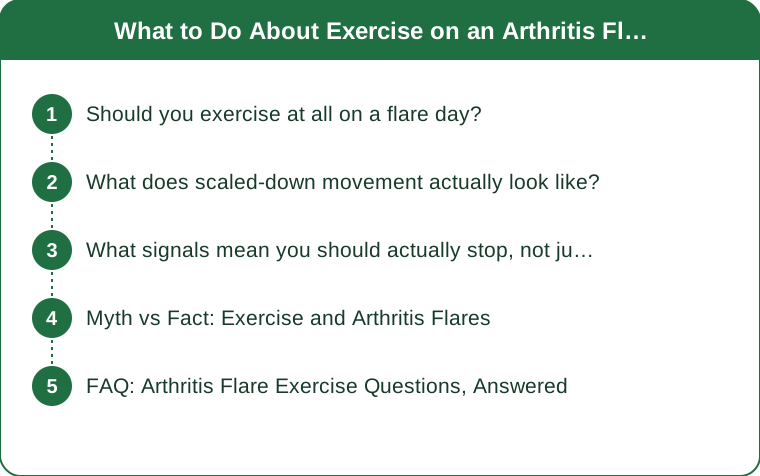
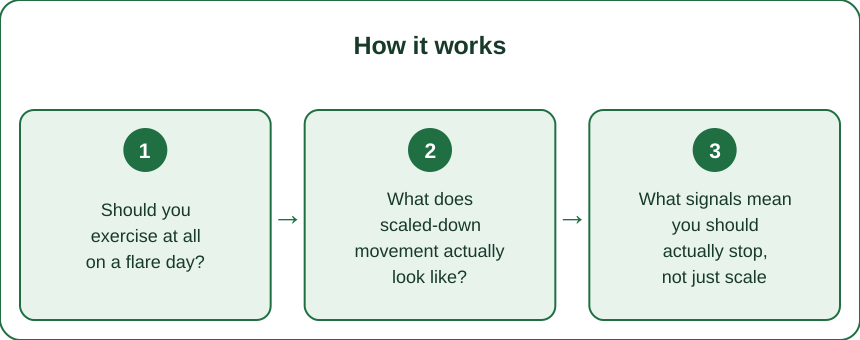
Should you exercise at all on a flare day?
For most people with arthritis, some gentle movement is generally preferable to complete rest, since joints tend to stiffen further with total inactivity — but ‘some movement’ on a flare day looks very different from a regular session.
This is a general pattern, not a rule for every individual case — if you have specific guidance from a rheumatologist or physical therapist about your particular flares, that guidance takes priority.
What does scaled-down movement actually look like?
Gentle range-of-motion exercises — slow, controlled joint movement through a comfortable arc, without added resistance or weight — rather than your usual strength or cardio session.
Think 5-10 minutes of slow shoulder rolls, ankle circles, or gentle stretching rather than a full workout scaled slightly down. The goal on a flare day is maintaining mobility, not building fitness.

What signals mean you should actually stop, not just scale down?
Sharp pain (different from dull achiness), swelling that increases during movement, or pain that worsens rather than eases as you continue — these are signals to stop entirely rather than push through at a lower intensity.
Mild stiffness that loosens slightly as you move is a normal part of many flare days; pain that clearly escalates the longer you move is a different, more concerning signal.
Myth vs Fact: Exercise and Arthritis Flares
Myth: Any pain during exercise means you should stop all movement until the flare fully passes. Fact: Complete inactivity during a flare can sometimes increase stiffness — gentle, appropriately scaled movement is often still beneficial, distinct from pushing through sharp or worsening pain.
Myth: A flare means your exercise program has failed. Fact: Flares are a normal part of many arthritis conditions and don’t reflect a failed program — the response (scale down, don’t stop) is what matters, not the flare’s occurrence itself.
Myth: You should return to full intensity as soon as the pain eases slightly. Fact: A gradual return over several days, rather than jumping straight back to full intensity, tends to reduce the chance of triggering another flare shortly after.
FAQ: Arthritis Flare Exercise Questions, Answered
How long should you stay at reduced intensity after a flare?
There’s no universal number, but easing back gradually over several days rather than an immediate full return is a commonly recommended, cautious approach.
Is heat or cold better before gentle movement during a flare?
Both are used depending on individual preference and the specific joint — some people find heat loosens stiffness before movement, while cold helps manage active swelling; a rheumatologist or PT can advise on your specific case.
When should a flare prompt a call to your doctor rather than just self-management?
If a flare is unusually severe, involves significant swelling, or doesn’t follow your typical pattern, that’s worth a call rather than assuming it will resolve like previous flares. This is general information, not medical advice.
TL;DR:
- Gentle movement is often preferable to complete rest on a flare day, but intensity should drop significantly
- Scale to slow range-of-motion work, not your regular routine at reduced weight
- Sharp or worsening pain is a stop signal — mild stiffness that eases with movement is not
- Return to full intensity gradually over several days, not immediately once pain eases
A flare changes the plan for the day, not the whole program — scaling down keeps the habit alive without pushing through the wrong kind of pain. This is general information, not medical advice.
Keep Reading
This article is for general informational purposes only and is not medical advice. Always consult a qualified health professional for guidance specific to you.