Shoes and Arthritis: What Actually Reduces Load on Sore Joints
Quick Answer: For knee and hip osteoarthritis, the most consistent findings favour stable, cushioned, flexible shoes with good arch support and a low heel - and evidence for specialised lateral-wedge insoles has been disappointing. Rocker-sole shoes may help some people. What matters most in practice is that the shoe fits a possibly altered foot shape, is easy to put on, and is comfortable enough that you keep walking.
Everybody has an opinion about shoes and joint pain, and most of the confident advice is either a marketing claim or someone’s personal experience. The research picture is messier and, in places, genuinely surprising.

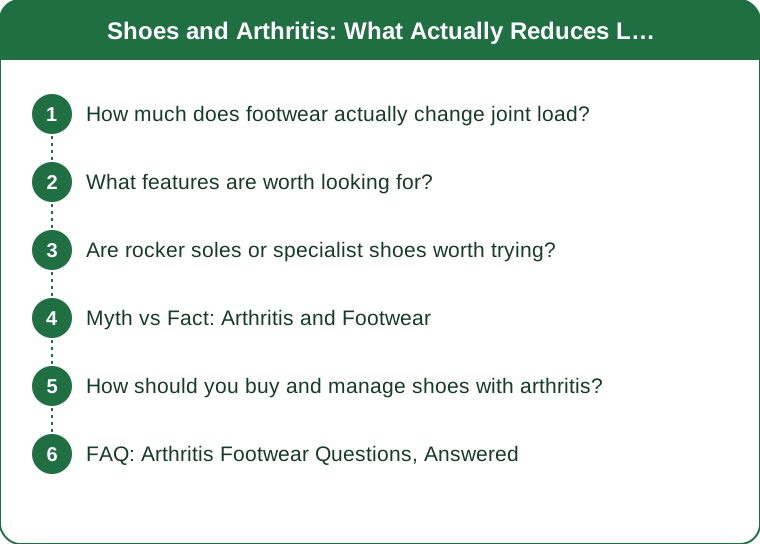
How much does footwear actually change joint load?
Enough to matter, and less than the more dramatic marketing suggests.
Walking generates forces at the knee of several times body weight, and the way that force is distributed across the joint surface depends partly on the alignment of your leg and partly on what is under your foot. Footwear changes the second of those.
Measurable effects footwear has:
- The knee adduction moment - a measure of how much load passes through the inner compartment of the knee, where osteoarthritis most often occurs - varies meaningfully between shoe types
- Peak impact forces at heel strike, which cushioning reduces
- Ankle and foot position, which changes how force transmits up the chain
- Stability, which affects how much muscular work is needed to control each step
What the research broadly suggests for knee osteoarthritis:
- High heels increase knee load and are best minimised - this finding is consistent
- Very flexible, flat, minimal shoes have shown benefit in some studies, possibly by allowing more natural foot mechanics, though results are mixed and they suit fewer people
- Stable supportive shoes with cushioning perform well in trials for comfort and function, and a notable study found them no worse than flat flexible shoes over six months, with fewer people reporting problems
- Lateral-wedge insoles, once widely recommended, have not held up well - larger trials and reviews have generally found little benefit over control insoles
The honest summary: footwear is a real but modest lever, and comfort and adherence matter more than any specific design claim.
What features are worth looking for?
Practical, checkable features rather than marketing language.
A stable heel counter. Squeeze the back of the shoe - it should resist rather than fold. This controls heel movement and reduces the muscular work of stabilising each step.
Adequate cushioning, not maximum cushioning. Some shock absorption at the heel reduces impact forces. Extremely soft, tall midsoles reduce stability, which can be a worse trade for anyone with balance concerns or ankle arthritis.
A low heel - under about 2.5cm. Heel height increases knee load progressively. This is one of the clearest findings there is.
Arch support that matches your foot. Support that fits helps; support that fights your foot shape creates new problems. If your arch has flattened, that is where support belongs.
Flexibility at the forefoot. The shoe should bend where your toes bend, not in the middle of the arch. Twist it - it should resist torsion but flex at the ball.
A wide, deep toe box. Essential if you have any toe joint involvement, bunions, or hammer toes, and often the difference between wearable and unwearable.
Easy fastening. Velcro, elastic laces, or a wide opening. If hand arthritis makes lacing painful, a technically ideal shoe you cannot fasten is the wrong shoe.
Removable insoles, so orthotics can be added later without changing shoes.
What to avoid: heels above 4cm, completely flat unsupportive flats, backless shoes that require gripping with your toes, and heavy boots that increase the work of each swing.
Are rocker soles or specialist shoes worth trying?
Some are worth a trial, with realistic expectations.
Rocker-sole shoes. These have a curved sole that rolls you through the step rather than requiring the foot and toes to bend. Evidence suggests they can reduce load at the ankle and forefoot and may help some people with knee osteoarthritis, and they are frequently useful for big-toe joint arthritis where bending the toe is the painful part. The downside is they feel unstable to some people initially and need a few weeks of adjustment.
Lateral-wedge insoles. Once a mainstream recommendation for medial knee osteoarthritis. Larger trials and systematic reviews have generally not found meaningful benefit over control insoles, so they are no longer widely recommended as a first-line approach. Some individuals do respond, which is why a trial with a podiatrist is reasonable if other things have not worked.
Cushioned running shoes. Frequently a good practical answer. Stable, cushioned, well-fitted, easy to find, and comfortable enough that people actually walk in them, which is the outcome that matters most.
Custom orthotics. Useful where there is a specific structural issue - a marked leg length difference, significant flat foot, or forefoot deformity. Less useful as a general arthritis intervention.
Minimal or barefoot-style shoes. Some studies have found benefit for knee load, but they demand more from the foot and require a slow adaptation. Not a good choice if you have foot arthritis or a flattened arch.
A reasonable order to try things: get a properly fitted stable cushioned shoe first, walk in it for a month, and only then consider specialist options with a podiatrist or physiotherapist. This is general information, not medical advice.

Myth vs Fact: Arthritis and Footwear
Myth: The softest, most cushioned shoe is always best for sore joints. Fact: Some cushioning helps with impact, but very soft tall midsoles reduce stability and increase the muscular work of balancing. For anyone with balance concerns or ankle involvement, a moderately cushioned stable shoe is usually the better choice.
Myth: Arch support insoles will fix knee arthritis pain. Fact: Insoles can help with foot symptoms and specific structural issues. The evidence that they meaningfully change knee osteoarthritis pain - lateral wedges especially - is weak. They are worth trying, not worth expecting a lot from.
Myth: Going barefoot at home is best for arthritic joints. Fact: Barefoot on hard floors gives you no cushioning and no support, and many people with foot or knee arthritis report more symptoms. A supportive indoor shoe or firm slipper covers a large share of your weekly steps and is one of the most underrated changes available.
Myth: If a shoe is comfortable in the shop, it is the right shoe. Fact: Shop comfort is a poor predictor of comfort at kilometre three or hour six. It is still worth taking seriously - discomfort in the shop is a definite no - but a proper trial over several days indoors is what tells you.
Myth: Expensive shoes are better for arthritis. Fact: Price mostly buys weight savings and upper materials. The features that matter here - stable heel, low heel height, wide toe box, appropriate cushioning, easy fastening - are available at mid-range prices.
How should you buy and manage shoes with arthritis?
The buying process matters nearly as much as the shoe.
Shop in the late afternoon. Feet swell across the day, and joint swelling makes this more pronounced. A morning fitting produces a shoe that hurts by evening.
Measure both feet, every time. Foot shape changes over years, and arthritis can change it faster - joint changes, swelling, and altered gait all affect fit. Fit the larger foot.
Prioritise width and depth. The most common fitting failure with arthritic feet is not length but a toe box that is too shallow or narrow. Pressure over a prominent joint creates a new problem on top of the old one.
Test what you actually do. Walk on a hard floor, use stairs if the shop has them, and stand still for a minute. Sitting on a bench flexing your toes tells you very little.
Replace them on function. Press your thumb into the midsole - dead foam stays dented. A shoe that has lost its cushioning is doing none of the job you bought it for, however new the upper looks.
Own two pairs and alternate. Foam recovers over roughly 24 hours, so both pairs stay more supportive and last longer in calendar terms.
Do not forget indoor footwear. Most people spend most of their steps at home. A supportive indoor pair is frequently the highest-return purchase for anyone with knee or foot arthritis.
And keep walking. Whatever the shoe, regular activity is one of the best-supported interventions for osteoarthritis. The right shoe is the one that keeps you moving. If pain is limiting your walking, that is a conversation for your doctor or physiotherapist rather than a shopping problem.
FAQ: Arthritis Footwear Questions, Answered
Are trainers acceptable to wear all the time?
For most people with knee, hip, or foot arthritis, a stable cushioned trainer is a sensible default. Consider alternating between two pairs and having a smarter equivalent with similar features for occasions where trainers do not fit.
Can I still wear heels sometimes?
Occasional short wear is a personal trade-off rather than a prohibition. Heel height increases knee load fairly consistently, so lower heels, shorter durations, and a comfortable pair to change into afterwards is the practical compromise.
Do compression socks help arthritis?
They help some people with swelling and a feeling of support, particularly in the ankle and foot. They do not change joint load. If you have circulation problems or diabetes, check with your doctor before using compression.
How do I manage shoes if my hands are the problem?
Look for elastic laces, wide velcro straps, or slip-on styles with a firm heel counter, plus a long-handled shoe horn. A shoe you can put on independently is worth more than a marginally better sole you need help with.
TL;DR:
- Stable, cushioned, flexible shoes with a low heel and good fit are the most consistently supported choice
- Heel height reliably increases knee load; lateral-wedge insoles have largely not held up in trials
- Rocker soles are worth a trial, especially for big-toe joint arthritis, with a few weeks of adjustment
- Prioritise toe box width and depth, a firm heel counter, and fastening you can manage
- Buy in the late afternoon, fit the larger foot, alternate two pairs, and get supportive indoor shoes
Footwear is a modest lever pulled thousands of times a day, which is why it is worth getting right and not worth agonising over. The shoe that keeps you walking comfortably is beating the technically optimal one you left in the cupboard.
Keep Reading
This article is for general informational purposes only and is not medical advice. Always consult a qualified health professional for guidance specific to you.