When Your Hands Give Out Before Your Muscles Do: Arthritis-Friendly Gym Fixes
Quick Answer: If hand pain ends your sets before the target muscle is tired, the problem is the interface, not your strength. Wrist straps, thick-grip sleeves, neutral-grip handles, machines instead of free weights, and wearable loops each remove hand demand from a different exercise. Strength training is well supported for arthritis and generally recommended, so the goal is finding the version you can do rather than avoiding loading altogether. Talk to your rheumatologist or a physiotherapist about your specific joints first.
You set the row down not because your back was finished but because your fingers were. That is an extremely common and extremely fixable situation.

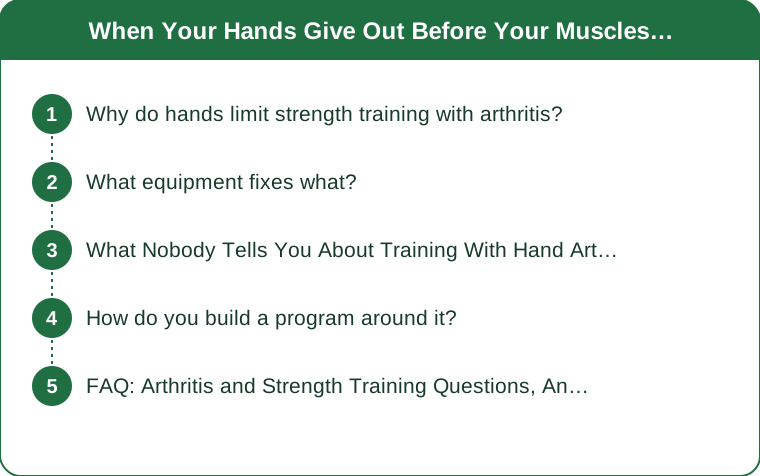
Why do hands limit strength training with arthritis?
Gripping requires sustained force through small joints under compression. The finger joints and the base of the thumb are common sites for osteoarthritis, and a grip on a barbell loads them continuously for the duration of the set - unlike the target muscle, which is loaded intermittently through the movement.
The load concentrates on a very small contact area. A standard one-inch bar presses into a narrow strip of the fingers, which increases pressure at those joints. This is why the same weight feels dramatically different on a thick handle.
Pulling exercises are affected most. Rows, pulldowns, deadlifts, and carries all rely entirely on grip to transmit force. Pushing exercises usually do not, which is why people with hand arthritis often find their pressing progresses fine while their pulling stalls completely.
Morning stiffness changes the picture by time of day. Inflammatory arthritis in particular tends to be worst on waking and better later, so an afternoon or evening session is often meaningfully more productive than an early one - a scheduling change with no equipment cost.
And the frustrating part is that the training is worth doing. Resistance training is generally recommended for arthritis, with evidence supporting improvements in pain, function, and quality of life. Being blocked at the hand is a genuine loss, which is why it is worth solving properly rather than working around by avoiding pulling.
What equipment fixes what?
Wrist straps for all pulling movements. A strap wraps around the bar and transfers load to the wrist and forearm, letting the fingers stay comparatively relaxed. This is the single highest-value item and it is inexpensive. Figure-eight straps hold even more securely and are easier to apply with limited dexterity than standard lasso straps.
Thick-grip sleeves for dumbbells and bars. Foam or rubber sleeves increase handle diameter substantially, which spreads pressure over a wider contact area and often reduces joint pain markedly. They are removable and fit most standard bars.
Neutral-grip handles wherever possible. A palms-facing-each-other grip is generally more comfortable for thumb-base arthritis than a pronated one. Many machines offer both; free-weight equivalents exist for most pulling movements.
Machines and cables instead of free weights. Machines remove the need to stabilize and often let you use a supported handle position. A chest-supported row with a neutral handle asks far less of the hand than a bent-over barbell row does.
Wearable wrist loops or hooks for heavy carries and deadlifts. These transfer essentially all the load off the fingers. Some people consider them a step too far for general training, which is a preference argument that does not apply when the alternative is not training the movement at all.
And resistance bands with wide, soft handles or loop attachments. Bands can be looped around the forearm entirely, removing the hand from the equation, which makes them useful on flare days.

What Nobody Tells You About Training With Hand Arthritis
Isometric grip work can help rather than hurt, at the right dose. Gentle grip strengthening - a soft ball or putty, short holds, well below pain threshold - is often part of hand therapy programs. The instinct to rest the hands completely is usually not the right one, though the appropriate dose is individual and worth getting from a hand therapist.
Warmth before training makes a real difference. Ten minutes in warm water, or a heat pack on the hands, before a session noticeably improves comfort and range for many people. It is the cheapest intervention available and it is almost universally under-used.
The exercise that hurts may have an identical substitute. Almost every movement has a variation with a different hand demand. A trap bar deadlift with neutral handles instead of a straight bar, a chest-supported row instead of a bent-over one, a landmine press instead of a barbell press. Being blocked on a specific exercise is rarely being blocked on the movement pattern.
Volume distribution matters more than total volume. Three shorter sessions a week are frequently better tolerated than two long ones, because cumulative time under grip load in a single session is what tends to provoke symptoms.
Flare days need a plan made in advance. Deciding what you will do on a bad hand day while you are having a bad hand day usually results in doing nothing. A written flare-day session - lower body, machines, band work looped at the forearm - removes that decision.
And pain during versus pain after are different signals. Mild discomfort during exercise that settles within an hour or two is generally acceptable in arthritis management. Pain that increases for 24 hours afterward, or joint swelling, means the dose was too high. This distinction is worth discussing with your clinician for your specific situation.
How do you build a program around it?
Audit which exercises fail at the hand. For two sessions, note every set you ended because of your hands rather than the target muscle. The list is usually shorter than expected and almost entirely pulling movements.
Apply the cheapest fix first. Straps on the pulling exercises. For many people that alone resolves most of the list, and it costs very little.
Then substitute what straps do not fix. Thick grips for dumbbell work, neutral handles for rows and pulldowns, machines where free weights remain uncomfortable.
Schedule around stiffness. If mornings are worse, train in the afternoon. This is free and it is one of the most reliable improvements available for inflammatory arthritis.
Keep pushing movements as they are. They rarely need modification, and they are where you can progress normally while sorting out the pulling side.
Track by target muscle, not by grip. The goal is that sets end because the back or the legs are done. When that becomes true, the interface problem is solved and normal progressive overload can resume.
And build the flare plan now. Write down a 25-minute session that requires no meaningful grip: leg press, chest-supported machine work, band exercises looped at the forearm, walking. Having it written removes the all-or-nothing decision on a bad day.
Talk to your rheumatologist or a physiotherapist before starting or changing a program, particularly with inflammatory arthritis or joint replacements. This is general information, not medical advice.
FAQ: Arthritis and Strength Training Questions, Answered
Can I lift weights with arthritis in my hands?
Usually yes, and resistance training is generally recommended for arthritis. When hand pain ends sets before the target muscle tires, the fix is equipment - straps, thick grips, neutral handles, machines - rather than avoiding the movement. Check with your clinician about your specific joints.
What are the best grip aids for arthritis?
Wrist straps are the highest-value first purchase for pulling exercises, with figure-eight straps being easier to apply with limited dexterity. Thick-grip foam or rubber sleeves spread pressure over a wider area and help significantly on dumbbells and bars.
Should I exercise during an arthritis flare?
Usually something rather than nothing, but modified. A pre-written flare session using leg machines, chest-supported work, and bands looped at the forearm avoids grip entirely. Mild discomfort during exercise that settles within a couple of hours is generally acceptable; pain increasing for 24 hours means too much.
Why is my grip worse in the morning?
Morning stiffness is characteristic of inflammatory arthritis in particular and often improves over the first hour or two. Training in the afternoon or evening instead is a free change that many people find substantially more productive.
TL;DR:
- If sets end at the hand rather than the target muscle, the interface is the problem, not your strength.
- Wrist straps fix most pulling movements and are the cheapest high-value change; figure-eight straps are easier with limited dexterity.
- Thick-grip sleeves spread pressure, neutral handles suit thumb-base arthritis, and machines remove stabilizing demand.
- Warm the hands for ten minutes beforehand and train in the afternoon if mornings are stiff.
- Write a flare-day session in advance so a bad hand day does not become a skipped week.
Discomfort during exercise that settles within a couple of hours is generally fine; pain rising for a day means the dose was too high. Check with your clinician.
Keep Reading
This article is for general informational purposes only and is not medical advice. Always consult a qualified health professional for guidance specific to you.