Humidity or Barometric Pressure? What Actually Triggers Your Joint Flares
Quick Answer: Barometric pressure change - particularly a falling pressure ahead of a storm - is the weather variable most consistently reported in connection with joint symptoms, more so than rain or humidity themselves. The proposed mechanism is that lower external pressure allows tissue around the joint to expand slightly, increasing pressure on already-sensitive structures. Tracking pressure alongside symptoms for a month tells you far more than tracking the forecast.
Everyone with arthritis has a theory about the weather, and most of them centre on rain. The research is messier and more interesting than that, and knowing which variable actually correlates for you changes what you can do about it.

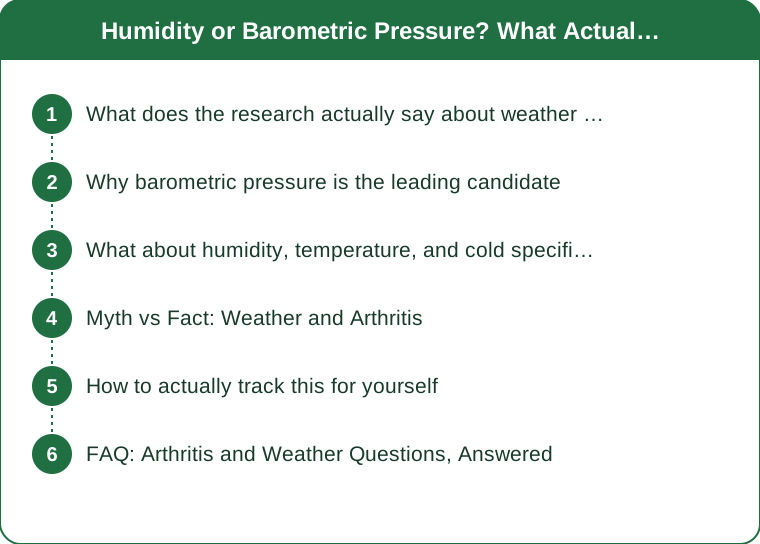
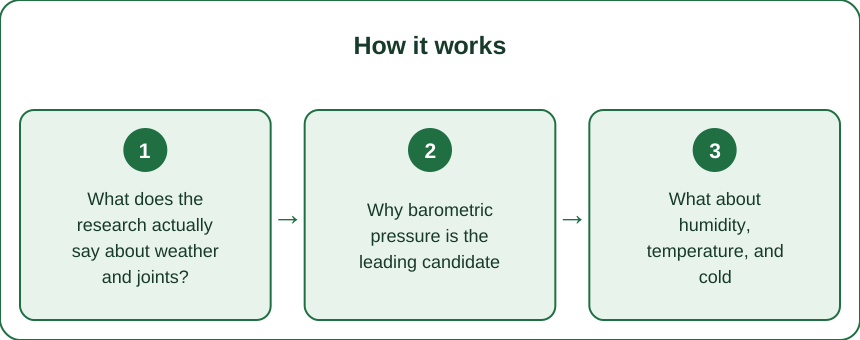
What does the research actually say about weather and joints?
The honest summary: the evidence is genuinely mixed, and anyone claiming certainty in either direction is overstating it.
Some studies find associations between weather variables and joint pain reports; others find no meaningful relationship. Large studies using smartphone-based symptom tracking have produced results pointing toward modest associations with humidity and pressure, while other analyses have found the effect to be small or inconsistent.
What’s more consistent is the individual pattern. Many people with arthritis report a reliable, personally predictable relationship between certain conditions and their symptoms, even where population-level studies show weak averages. These two things aren’t contradictory - a population average can be near zero while individuals within it have strong, opposite-direction responses that cancel out.
The practical conclusion: population research can’t tell you what affects you. Personal tracking can, and it takes about a month.
One important caveat: expectation shapes perception. If you believe rain worsens your joints, you’re more likely to notice and record symptoms on rainy days. This is why tracking should record symptoms daily regardless of weather, ideally before checking the forecast.
Why barometric pressure is the leading candidate
The proposed mechanism is specific and physically plausible.
Barometric pressure is the weight of the atmosphere pressing on you - roughly 1013 hPa at sea level on an average day, dropping to 990 or lower ahead of a significant storm system.
When external pressure falls, the pressure inside your body doesn’t drop instantly to match. The theory is that this brief imbalance allows soft tissue around a joint to expand very slightly, which in an already-inflamed or structurally compromised joint could increase pressure on sensitive structures.
This explains a pattern many people report: symptoms appear before the weather does, often 12-24 hours ahead of rain arriving. Pressure begins falling well before precipitation starts. If you find yourself saying the weather changed and your joints knew first, falling pressure is the most likely explanation.
Why rain gets the blame: rain is visible and pressure isn’t. The pressure drop that preceded it is invisible, so the correlation gets attributed to the thing you can see.
Practical implication: if pressure is your variable, a weather app showing barometric pressure trends gives you 12-24 hours of warning - which is enough time to adjust activity, take a scheduled medication on time, or plan a gentler day.
What about humidity, temperature, and cold specifically?
Humidity is the other commonly reported variable, and the proposed mechanisms are less clear than for pressure. High humidity often accompanies low pressure, which makes the two difficult to separate in everyday experience - one reason personal tracking of both is worthwhile.
High humidity also affects behaviour: people move less, sleep worse in humid heat, and both reduced movement and poor sleep independently worsen joint symptoms. Some of the humidity effect may be indirect.
Cold is widely reported and has a straightforward partial explanation: cold reduces tissue elasticity and can increase muscle tension around a joint, and people move less in cold weather. Whether cold has a direct effect on joint structures beyond this is less settled.
Temperature swings may matter more than absolute temperature. A rapid change in either direction is more commonly reported as a trigger than a stable cold or stable warm period.
Late summer is a particularly mixed period - high humidity, unstable pressure systems, and large day-to-night temperature swings all at once. If your symptoms have been unpredictable this month, that combination is a reasonable explanation.

Myth vs Fact: Weather and Arthritis
Myth: Moving to a warm dry climate cures arthritis. Fact: People who relocate often report initial improvement that fades over months. Climate may affect symptom experience; it doesn’t change the underlying joint condition.
Myth: If research is mixed, weather sensitivity is imaginary. Fact: Mixed population-level findings are entirely compatible with real individual patterns. Averaging opposite responses produces a near-zero average that describes nobody.
Myth: Rain is the trigger. Fact: Falling pressure typically precedes rain by 12-24 hours, which is when many people report symptoms starting. Rain is the visible marker, not necessarily the cause.
Myth: There’s nothing you can do about weather-related flares. Fact: If you can predict them 12-24 hours ahead, you can adjust activity, prioritise your morning mobility routine, and time medication as prescribed - which is meaningfully different from being caught unprepared.
Myth: A weather-triggered flare means the disease is progressing. Fact: Symptom fluctuation with environmental conditions is not the same as structural progression. Persistent worsening independent of weather is what warrants a medical conversation.
How to actually track this for yourself
One month of consistent tracking gives you more useful information than any general article, including this one.
What to record daily, at the same time:
- Pain level, 1-10, in your most affected joint
- Stiffness duration in minutes on waking
- Barometric pressure (most weather apps show it; some let you see the 24-hour trend)
- Humidity and temperature
- Two confounders that matter enormously: sleep quality and activity level the previous day
Record symptoms before checking the weather. This is the single most important methodological detail, and it’s what separates useful tracking from confirmation of what you already believe.
After a month, look for the lag. Compare today’s symptoms against yesterday’s pressure change, not today’s weather. If the correlation is with the change rather than the state, that’s the pressure mechanism showing up.
What to do with the answer: bring it to your next appointment. A month of structured data is genuinely useful clinical information and changes the conversation from vague to specific.
What tracking can’t do: replace treatment. If flares are becoming more frequent, lasting longer, or affecting new joints, that’s a medical conversation regardless of what the barometer says. This is general information, not medical advice.
FAQ: Arthritis and Weather Questions, Answered
How far ahead can weather-sensitive people usually predict a change?
Many report 12-24 hours, which lines up with when barometric pressure typically begins falling ahead of a system.
Does a dehumidifier help?
Some people report benefit, and it may help indirectly through better sleep in humid conditions. It’s a low-risk thing to try and easy to evaluate over a couple of weeks.
Should I change my medication schedule around forecasts?
Only in consultation with your doctor. Some people are advised to time doses around predictable patterns, but that’s a prescribing decision.
Is this different for osteoarthritis versus rheumatoid arthritis?
Weather sensitivity is reported in both, and research hasn’t clearly established that one is more affected. Personal tracking is the more useful approach either way.
TL;DR:
- Falling barometric pressure is the most plausible and most commonly reported weather variable, not rain itself
- Pressure drops 12-24 hours before rain, which explains symptoms that arrive before the weather
- Population research is mixed; individual patterns can still be real and predictable
- Track symptoms daily before checking the forecast, and include sleep and previous-day activity
- One month of structured tracking is genuinely useful information for your next appointment
This is general information, not medical advice - increasing or spreading symptoms warrant a doctor’s assessment.
Keep Reading
This article is for general informational purposes only and is not medical advice. Always consult a qualified health professional for guidance specific to you.