Morning Stiffness With Arthritis: A 10-Minute Routine That Helps
Quick Answer: Morning stiffness responds better to gentle movement than to waiting it out. A useful routine starts in bed with small range-of-motion movements, continues with seated mobility on the edge of the bed, and finishes with a short walk - roughly ten minutes total. Warmth before movement helps, and stiffness lasting well over an hour is worth mentioning to your doctor.
The alarm goes and the first twenty minutes are the worst part of the day. Stairs, kettle, and getting dressed all feel like negotiating something. Then by mid-morning it eases and you forget how bad it was until tomorrow.

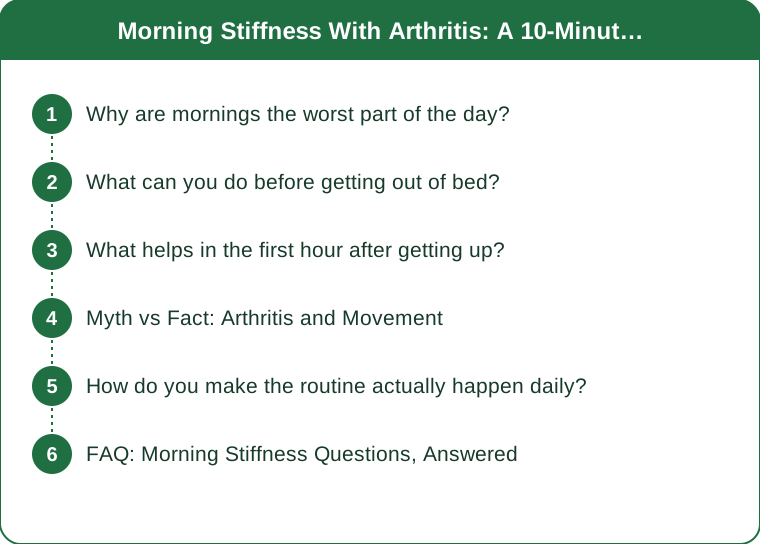
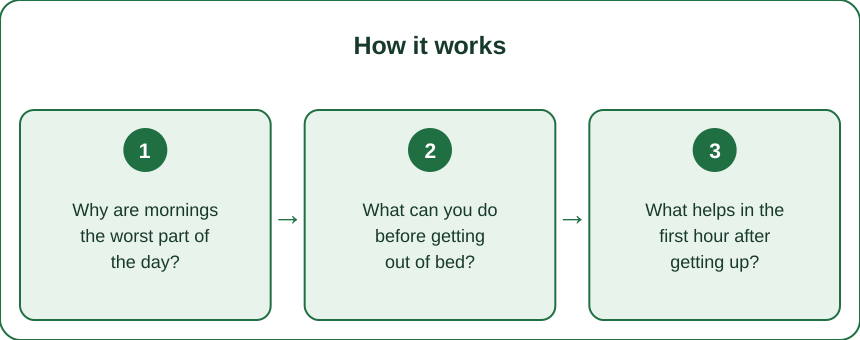
Why are mornings the worst part of the day?
Because joints stiffen during prolonged inactivity, and eight hours of sleep is the longest stretch of stillness you get.
Synovial fluid, which lubricates joints, becomes more viscous when a joint has not moved for a long period. Movement warms and thins it, which is why the stiffness eases with activity rather than with rest - the opposite of what instinct suggests.
Inflammatory activity also follows a daily rhythm. In inflammatory arthritis, inflammatory markers tend to peak in the early hours, which is part of why morning symptoms are more pronounced. Cortisol, which has anti-inflammatory effects, is at its lowest in the late night before rising toward morning.
Duration is diagnostically meaningful:
- Under 30 minutes of morning stiffness is more typical of osteoarthritis
- Over an hour, particularly with swelling and affecting both sides of the body, is more associated with inflammatory arthritis such as rheumatoid arthritis
This distinction matters clinically. If your morning stiffness regularly lasts more than an hour, that is worth reporting to your doctor, particularly if it is a change from your usual pattern. It is one of the specific things clinicians ask about. This is general information, not medical advice.
What can you do before getting out of bed?
Three or four minutes of small movements, done lying down, that make the first steps considerably easier.
Work from the feet up:
- Ankle circles, 10 each direction, each foot. Start here - ankles and feet take your weight the moment you stand.
- Point and flex the feet, 10 slow repetitions
- Knee slides - slide one heel toward you along the bed and back, 8 per side, gently and within comfort
- Gentle knee rocks - knees bent, feet flat, let both knees fall a small way to one side and back, 8 per side
- Shoulder rolls, 8 backward, lying on your back
- Hand opening and closing, 10 slow repetitions, then gentle finger spreads
- Wrist circles, 8 each direction
How it should feel: easy. This is range of motion, not stretching and not strengthening. Move to the edge of comfortable and no further - pushing into pain in the morning tends to make the whole day worse.
Take your time. Two to four minutes, breathing normally. Rushing the sequence removes most of the benefit, since the point is gradually reintroducing movement to joints that have been still for hours.
What helps in the first hour after getting up?
Warmth, then movement, then a short walk. In that order.
Warmth first. A warm shower, a heat pack, or simply warm water over stiff hands makes subsequent movement noticeably easier. 5 to 10 minutes is enough. For some people a warm shower before any other movement is the single most useful thing in the routine.
Then seated mobility on the edge of the bed or a chair, roughly 4 minutes:
- Seated marching, lifting each knee gently, 10 per side
- Seated knee extensions - straighten one leg out, lower it slowly, 8 per side
- Neck turns, slowly looking left and right, 6 each way, plus gentle ear-to-shoulder tilts
- Seated trunk rotations, hands on thighs, small range, 8 per side
- Sit-to-stand, using hands on thighs if needed, 5 repetitions - the most functionally useful movement in the sequence
Then walk. Even three to five minutes around the house helps considerably. Walking is the most effective general de-stiffener because it moves nearly every lower body joint through repeated cycles.
A note on cold: heat generally suits stiffness, and cold generally suits an acutely swollen, hot joint. Many people use heat in the morning and cold later if a joint flares. Both are reasonable, and personal response varies enough that it is worth testing which works for you.

Myth vs Fact: Arthritis and Movement
Myth: Exercise wears out arthritic joints faster. Fact: The evidence points the other way. Appropriate exercise is one of the core recommended management strategies for osteoarthritis, and it is associated with reduced pain and better function. Muscles supporting a joint reduce the load through it. Prolonged inactivity is what leads to weakness and increased pain.
Myth: If it hurts, you should stop moving that joint. Fact: There is a difference between discomfort and harm. Mild aching during and shortly after gentle movement is common and generally acceptable. Sharp pain, or pain that is clearly worse for hours afterwards, is a signal to reduce intensity - not to stop moving altogether.
Myth: Morning stiffness means the arthritis is getting worse. Fact: Stiffness varies day to day with sleep, weather, activity the previous day, and in inflammatory arthritis with disease activity. A single bad morning tells you little. A sustained change in the usual pattern over weeks is worth reporting.
Myth: You should wait until the stiffness passes before moving. Fact: Gentle movement is what shortens it. Waiting extends it. This is the single most useful reversal for most people and it is genuinely counterintuitive.
Myth: Cracking or clicking joints means damage. Fact: Painless clicking is extremely common and generally not a concern on its own. Clicking accompanied by pain, swelling, or locking is worth having assessed.
How do you make the routine actually happen daily?
Habit design, because a routine done twice a week gives a fraction of the benefit.
Attach it to something fixed. The alarm going off is the anchor for the in-bed portion - you are already there and nothing else competes for that moment. This is the easiest habit anchor available in the whole day.
Keep the equipment at the bed. If you use a heat pack, keep it within reach. Anything requiring a trip downstairs first will not survive a bad morning.
Write the sequence on a card and keep it on the bedside table for the first few weeks. Remembering an order while stiff and half awake is more effort than it sounds, and a card removes it entirely.
Scale it on bad days rather than skipping. On a difficult morning, do the in-bed portion only. Three minutes on a bad day preserves the habit, and preserving the habit is what makes the good days consistent.
Track it simply. A mark on a calendar. After a month you will have a visible record, and more usefully you can look back and see whether particularly bad mornings follow particular days - a heavy activity day, poor sleep, or a missed medication.
Expect a few weeks. Improvements in stiffness duration from a consistent routine build gradually. Judging after three mornings is not enough to tell you anything.
Talk to a physiotherapist if you can - a routine adapted to your specific joints and your specific type of arthritis will always be better than a general one. Many places allow self-referral. This is general information, not medical advice.
FAQ: Morning Stiffness Questions, Answered
How long should morning stiffness normally last?
With osteoarthritis it commonly eases within about 30 minutes. With inflammatory arthritis it often lasts an hour or more. Stiffness that regularly exceeds an hour, or that has changed noticeably from your normal pattern, is worth discussing with your doctor.
Does the weather really affect stiffness?
Many people report it consistently, particularly around changes in barometric pressure and damp cold. Research findings are mixed and the effect, if present, appears small. Your own experience is worth respecting regardless of what studies show on average.
Should I exercise on a flare day?
Usually gentle range-of-motion movement is still appropriate and helpful, while strengthening and higher-intensity work is best reduced. During an acute flare of an inflammatory arthritis, follow the guidance from your rheumatology team.
Is heat or cold better?
Heat generally suits stiffness and cold generally suits an acutely swollen, hot joint. Many people use heat in the morning routine and cold later in the day if needed. Individual response varies enough that experimenting is reasonable.
Can changing my mattress or sleep position help?
Some people find it does, particularly with hip and shoulder symptoms. There is no strong general evidence for a specific mattress type. A pillow between the knees when side-lying is a low-cost thing to try for hip and back comfort.
TL;DR:
- Stiffness eases with gentle movement, not with waiting - the counterintuitive part that matters most
- Start in bed: ankle circles, knee slides, shoulder rolls, hand and wrist movements, 3 to 4 minutes
- Warmth first, then seated mobility including five sit-to-stands, then a short walk
- Scale down on bad days rather than skipping, to keep the habit intact
- Stiffness regularly lasting over an hour, or a clear change in pattern, is worth reporting to your doctor
Ten minutes will not remove morning stiffness, but it shortens the difficult window and makes the first hour considerably more manageable. Done daily for a few weeks, most people find the whole morning starts from a better place. This is general information, not medical advice - a physiotherapist can tailor this to your joints specifically.
Keep Reading
This article is for general informational purposes only and is not medical advice. Always consult a qualified health professional for guidance specific to you.