Why Your Joints Hurt Most in the Morning - and What Sleep Position Changes
Quick Answer: Morning joint stiffness comes from inflammatory fluid accumulating during hours of immobility, and it is made worse by sleeping positions that hold a joint at end range all night. Supporting joints in a mid-range neutral position with pillows, keeping the bedroom moderately warm, and doing three to five minutes of gentle movement before getting out of bed typically reduces morning stiffness noticeably within two weeks.
The first ten minutes of the day being the worst ten minutes is one of the most consistent experiences in arthritis, and one of the least addressed - most advice starts once you’re up.
This is general information, not medical advice. Morning stiffness lasting longer than an hour, particularly with swelling, is a feature worth reporting to your clinician - it helps distinguish inflammatory arthritis from osteoarthritis and can change treatment.


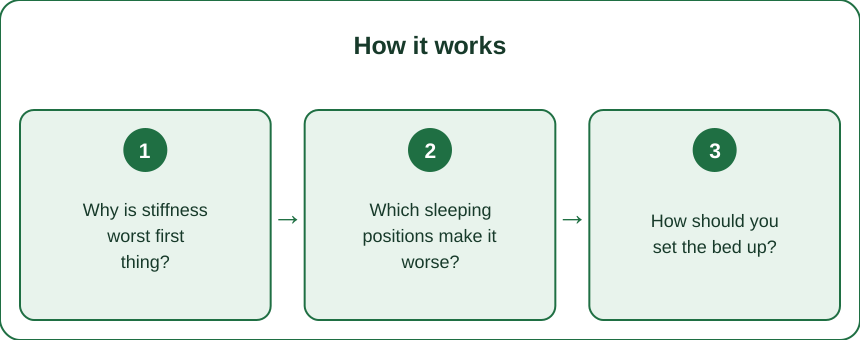
Why is stiffness worst first thing?
Two mechanisms overlap, and knowing which is dominant for you changes what helps.
Immobility and fluid. Joint fluid becomes more viscous when a joint stays still, and inflammatory fluid accumulates in and around the joint capsule overnight. Movement circulates it and thins it - which is why the stiffness eases as you move rather than as time passes.
Circadian inflammation. Inflammatory activity has a daily rhythm, and in inflammatory arthritis several key markers peak in the early hours of the morning. This is why morning stiffness in rheumatoid arthritis is often severe and prolonged, and why the timing of some medications is deliberately set around it.
The clinically useful distinction:
- Osteoarthritis: morning stiffness typically resolves within about 30 minutes and is often worse after activity the day before
- Inflammatory arthritis: stiffness typically lasts longer than an hour and is often accompanied by visible swelling
If yours regularly exceeds an hour, tell your clinician the number. Duration is a specific piece of diagnostic information, and patients rarely think to report it.
Which sleeping positions make it worse?
Any position that holds a joint at the very end of its range for hours.
Hands and wrists. Sleeping with wrists curled under the pillow or the body holds them in full flexion all night. For anyone with hand arthritis or carpal tunnel symptoms, this is the single biggest contributor to morning hand pain and numbness. A soft wrist splint worn at night keeps the wrist neutral and is one of the most reliably effective interventions available.
Knees. Sleeping on your side with knees stacked and unsupported compresses the upper knee and pulls the hip into adduction. A pillow between the knees keeps both joints neutral.
Hips. Sleeping on the affected side directly compresses it. If side-sleeping is unavoidable, a mattress topper that lets the shoulder and hip sink slightly reduces the pressure considerably.
Neck and shoulders. A pillow that’s too high or too low holds the neck at end range. Sleeping with an arm overhead compresses the shoulder for hours and is a common cause of morning shoulder pain that has nothing to do with the shoulder itself.
Spine. Stomach sleeping holds the neck rotated and the lower back extended. It’s the hardest position to modify because people revert to it in sleep - a body pillow to hug is the usual workaround, encouraging a side position.
How should you set the bed up?
Support, not softness. The goal is to hold joints in the middle of their range rather than to cushion them.
The pillow arrangement, by position:
Side sleeping - the most adaptable position for most people with arthritis:
- One pillow between the knees, thick enough to keep hips level
- One pillow hugged to the chest, supporting the top arm so the shoulder isn’t hanging forward
- A head pillow filling the gap between ear and shoulder exactly - too low pulls the neck down, too high pushes it up
Back sleeping:
- A pillow under the knees to reduce lower back extension
- A thinner head pillow than side sleeping requires
- Small rolled towel under the neck if the head pillow flattens the curve
Mattress: medium-firm is the general recommendation, and a very soft mattress lets joints settle into end range. A topper is a far cheaper test than a new mattress, and it answers the question in a fortnight.
Temperature: cold stiffens joints, and bedrooms cool substantially overnight in autumn. A moderately warm bedroom and adequate bedding help morning stiffness measurably - many people find the seasonal worsening they attribute to weather pressure is actually a bedroom that got cold at 4am.

Myth vs Fact: Morning Stiffness
Myth: Getting up and moving immediately is the best approach. Fact: Getting up abruptly on stiff joints is how people wrench a knee or a back first thing. A few minutes of gentle movement in bed - ankle circles, knee bends, gentle fists, shoulder rolls - primes the joints before they’re loaded.
Myth: A firmer mattress is always better for joints. Fact: Medium-firm generally outperforms both very firm and very soft in studies of back pain. Very firm creates pressure points at hip and shoulder for side sleepers, which is its own problem.
Myth: Weather causes morning stiffness. Fact: Evidence on barometric pressure and joint pain is genuinely mixed. Temperature has a clearer effect, and bedroom temperature is something you can control - which makes it worth addressing before concluding the weather is to blame.
Myth: If it hurts in the morning, you overdid it yesterday. Fact: In osteoarthritis, that’s often true. In inflammatory arthritis, morning stiffness follows its own rhythm largely independent of yesterday’s activity - which matters, because people frequently stop exercising based on a misread signal.
Myth: Sleeping more will help. Fact: More hours of immobility can mean more stiffness on waking. Sleep quality helps - poor sleep genuinely amplifies pain perception - but simply staying in bed longer often makes the first ten minutes worse, not better.
What should the first ten minutes look like?
A short in-bed routine before your feet touch the floor. Three to five minutes, done lying down.
The sequence:
- Ankle pumps - point and flex, 20 each foot. Starts circulation before you stand.
- Knee slides - slide one heel toward you and back, 10 each side
- Gentle fists - open the hand fully, close to a soft fist, 15 times. Do not squeeze hard.
- Wrist circles - 10 each direction
- Shoulder rolls - 10 backward
- Knee rocks - knees bent, feet flat, rock both knees slowly side to side, 10 each way
- Sit up slowly, then sit on the edge of the bed for 30 seconds before standing
Then, once up: a warm shower is genuinely useful, not just pleasant - heat increases tissue extensibility and reduces the perception of stiffness. For hands specifically, running them under warm water for a minute before trying to do anything fiddly makes a real difference.
What to expect: most people notice the routine shortening their stiff period within one to two weeks. It doesn’t reduce inflammation - it reduces how long you spend waiting for the joints to loosen, which is the part that shapes the whole morning.
FAQ: Sleep and Arthritis, Answered
Are night splints worth trying for hands?
For hand and wrist arthritis and for carpal tunnel symptoms, soft night splints have reasonable support and are inexpensive. They keep the wrist neutral through the hours you can’t control your position. Worth asking a hand therapist about fit.
Does an electric blanket help?
Many people find gentle warmth overnight reduces morning stiffness, and it addresses the bedroom-temperature factor directly. Use a low setting and a timer rather than high heat all night, and take care if you have reduced sensation.
Should I take pain medication before bed or in the morning?
This is worth a specific conversation with your prescriber - for inflammatory arthritis, timing medication to cover the early-morning inflammatory peak is a recognised strategy, and it’s not something to adjust independently.
Will a new mattress fix this?
Sometimes, and it’s an expensive first test. Try a topper, a pillow between the knees, and the bedroom temperature change first - all three cost little and address the same mechanisms.
TL;DR:
- Morning stiffness comes from overnight immobility plus a circadian inflammatory peak
- Positions that hold a joint at end range for hours are the controllable part
- Pillow between the knees, supported top arm, wrist splints for hands, no arm overhead
- Medium-firm support and a moderately warm bedroom both reduce morning stiffness
- Do three to five minutes of gentle movement in bed before standing up
- Stiffness lasting over an hour is diagnostic information - report the duration to your clinician
You can’t change the inflammatory rhythm from your bedroom. You can change the eight hours of position that sit on top of it, and that alone shortens most people’s worst ten minutes of the day.
Keep Reading
This article is for general informational purposes only and is not medical advice. Always consult a qualified health professional for guidance specific to you.