What to Do With Exercise During an Arthritis Flare - Rest Is Not the Only Option
Quick Answer: During a flare, most guidance supports reducing intensity and load while maintaining gentle movement through the available range, rather than resting completely. Complete rest tends to increase stiffness and deconditioning, which makes the return harder. A practical rule used in rehabilitation is that pain during activity should stay tolerable and should settle back to baseline within about 24 hours - if it stays elevated longer, that session was too much. Warmth, gentle range of motion, and reduced-load versions of your usual exercises are the working toolkit.
The flare arrives and the choice feels binary: do nothing and lose everything you built, or push through and pay for it. There is a third option, and it is the one physical therapists actually use.
This is general information, not medical advice - flare management should be discussed with your rheumatologist or physical therapist, particularly for inflammatory arthritis.

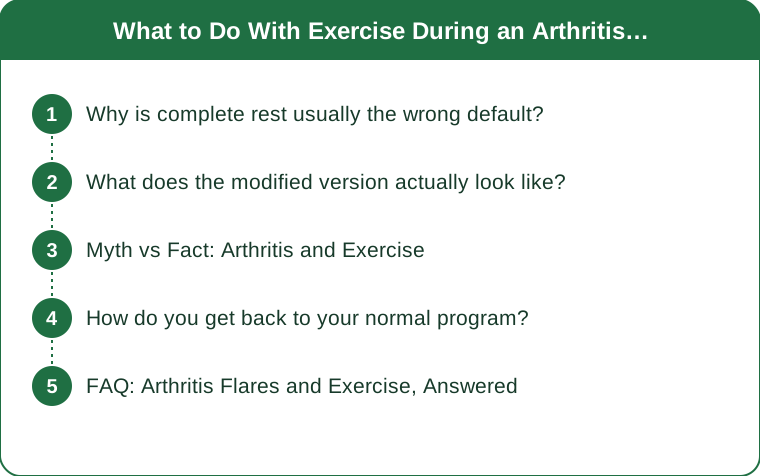
Why is complete rest usually the wrong default?
Joints depend on movement for cartilage health. Cartilage has no blood supply and relies on the compression and release of movement to circulate synovial fluid, which delivers nutrients and removes waste. Prolonged immobility works against the joint you are trying to protect.
Stiffness compounds quickly. Reduced movement leads to reduced range, which leads to more pain when you eventually move, which reinforces the avoidance. This cycle can turn a several-day flare into weeks of lost function.
Muscle loss starts faster than people expect. Measurable strength loss begins within days of significant inactivity, and the muscles around a joint are a meaningful part of what protects and stabilizes it.
Exercise is a core part of arthritis management in every major guideline. Physical activity is recommended for both osteoarthritis and inflammatory arthritis, with strong evidence for reduced pain and improved function over time. A flare is a reason to modify the plan, not to abandon it.
But this is not an argument for pushing through. Training hard through significant inflammation is genuinely counterproductive and can extend the flare. The target is the middle - reduced load, maintained motion.
And inflammatory arthritis differs from osteoarthritis here. In rheumatoid arthritis and similar conditions, a flare involves active systemic inflammation, and the threshold for backing off is lower. Anyone with inflammatory arthritis should have a flare plan agreed with their rheumatology team rather than improvising.
What does the modified version actually look like?
Keep the movement, cut the load. If you were doing loaded squats, do sit-to-stands from a chair. If you were walking 40 minutes, walk 10 minutes three times. The pattern continues; the demand drops.
Prioritize range of motion daily. Gentle, non-loaded movement through the joint’s comfortable range, several times a day, is the highest-value activity during a flare. For a knee, that might be seated flexion and extension; for hands, gentle fist-and-spread cycles.
Use the 24-hour rule to calibrate. Pain during activity should stay tolerable, and any increase should settle back to your baseline within about 24 hours. If you are still worse the next evening, reduce the next session. This rule is widely used in rehabilitation and it works well as a self-guided test.
Shift to non-weight-bearing options. Water is particularly useful during lower-limb flares - buoyancy reduces joint load substantially while allowing full range and gentle resistance. Cycling with low resistance is another reasonable substitute for walking.
Keep training what is not flaring. A wrist flare does not prevent lower body work. Maintaining training elsewhere preserves fitness and, just as importantly, preserves the habit, which is often the harder thing to rebuild.
And use warmth before, not after. Heat before gentle movement reduces stiffness and makes range work more comfortable. Cold can help after activity if a joint feels hot and swollen - though preferences vary considerably between people, and yours is worth knowing.

Myth vs Fact: Arthritis and Exercise
Myth: Exercise wears out arthritic joints faster. Fact: Appropriate physical activity is associated with better outcomes in osteoarthritis, not accelerated damage. The muscles around a joint contribute to its stability, and inactivity is more consistently associated with worse function.
Myth: If it hurts at all, stop. Fact: Some discomfort during activity is expected and acceptable in arthritis rehabilitation. What matters is whether it stays tolerable and settles within about 24 hours, not whether it exists.
Myth: You should not strength train with arthritis. Fact: Progressive resistance training is specifically recommended, and it improves pain and function. Exercise selection may need to avoid particular ranges, but the principle of loading is well supported.
Myth: Rest is the treatment for a flare. Fact: Relative rest - reduced intensity with maintained gentle motion - is what most guidance supports. Complete immobility increases stiffness and speeds deconditioning.
Myth: Cracking or noise from a joint means damage. Fact: Painless joint noises are common and not by themselves a sign of deterioration. Noise accompanied by pain, swelling, or locking is worth having assessed.
Myth: You will know when the flare is over because the pain stops. Fact: Function often recovers before pain fully resolves, and waiting for zero pain before resuming activity can delay the return unnecessarily. Reintroduce load gradually once pain is trending down and settling within 24 hours.
How do you get back to your normal program?
Reintroduce volume before intensity. Return to your previous duration or number of sessions at a lower load first, then rebuild the load over subsequent weeks. Doing both at once is the most common way people trigger a second flare.
Expect to come back below where you left off, and expect it to return quickly. Strength lost over one to two weeks of reduced activity typically rebuilds substantially faster than it took to build originally.
Use a 10 to 20 percent weekly progression as a ceiling. Increasing total weekly load beyond that is where flare-ups and overuse problems cluster.
Track flares rather than just enduring them. Noting the date, duration, what preceded it, and what helped builds a genuinely useful picture over months, particularly for identifying triggers that are not obvious in the moment.
Keep a written flare plan. Deciding what to do while in pain and frustrated is a bad time to make good decisions. A short list - which exercises to substitute, how long to hold the reduction, when to contact your care team - written while you are well is worth a great deal.
And know your red flags. New or severe joint swelling, redness and heat with fever, a joint that will not bear weight, or a flare that does not respond to your usual approach all warrant contacting your healthcare provider promptly rather than waiting it out.
This is general information, not medical advice. Discuss flare management and exercise modification with your rheumatologist or physical therapist.
FAQ: Arthritis Flares and Exercise, Answered
Should I exercise during an arthritis flare?
Usually yes, in modified form - reduced intensity and load with gentle range of motion maintained. Complete rest increases stiffness and speeds deconditioning, making the return harder, though inflammatory arthritis flares warrant a lower threshold and a plan agreed with your rheumatology team.
How much pain is acceptable during exercise with arthritis?
A common rehabilitation guideline is that pain should stay tolerable during activity and return to your baseline within about 24 hours. Pain that remains elevated the next day means the session was too much and the next one should be reduced.
What exercise is best during a flare?
Gentle range of motion several times a day, plus reduced-load versions of your usual movements - sit-to-stands instead of loaded squats, or short walks instead of long ones. Water-based exercise is particularly useful for lower-limb flares because buoyancy substantially reduces joint load.
How do I get back to normal training after a flare?
Rebuild volume first at a lower load, then increase load over following weeks, keeping total weekly increases to roughly 10 to 20 percent. Doing both at once is the most common cause of a second flare.
When should I contact a doctor about a flare?
For new or severe swelling, redness and heat with fever, a joint that will not bear weight, or a flare that does not respond to your usual management. These warrant prompt contact rather than waiting.
TL;DR:
- Complete rest during a flare increases stiffness and speeds strength loss - relative rest with maintained gentle motion is the better default.
- Keep the movement pattern and cut the load: sit-to-stands instead of loaded squats, three short walks instead of one long one.
- Use the 24-hour rule - pain should stay tolerable and settle to baseline within a day, or the next session should be smaller.
- Water and low-resistance cycling are the most useful substitutes during lower-limb flares.
- Rebuild volume before intensity, cap weekly increases around 10 to 20 percent, and write a flare plan while you are well.
- Contact your provider for severe swelling, heat with fever, or an unresponsive flare. This is general information, not medical advice.
The binary between stopping and pushing through is a false one. Almost every exercise you do has a lower-load version, and during a flare that version is the whole job.
Keep Reading
This article is for general informational purposes only and is not medical advice. Always consult a qualified health professional for guidance specific to you.