Your Phone Is a Hand-Arthritis Workout You Did Not Sign Up For
Quick Answer: The base-of-thumb joint takes several times the applied force during a pinch grip, and one-handed phone use is a sustained pinch with repeated thumb extension - which is why it aggravates thumb-base arthritis so reliably. The fixes are unglamorous and effective: hold the phone in two hands and type with index fingers, use voice dictation for anything over a sentence, drop the phone size or add a grip strap so you are not clamping, raise the phone to eye level so the neck and shoulder are not compensating, and take a 30-second break every 15 minutes. None of it requires giving up the phone.
Most hand-arthritis advice covers jar lids and kitchen tools. Meanwhile the actual highest-repetition gripping task in a modern day is the thing in your hand right now.

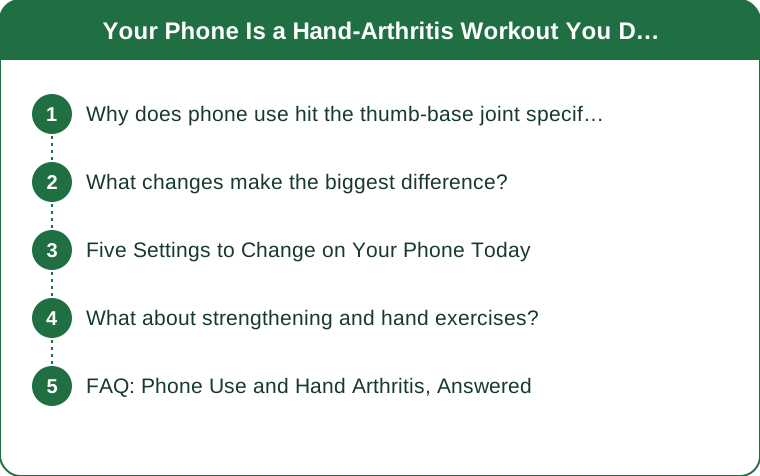
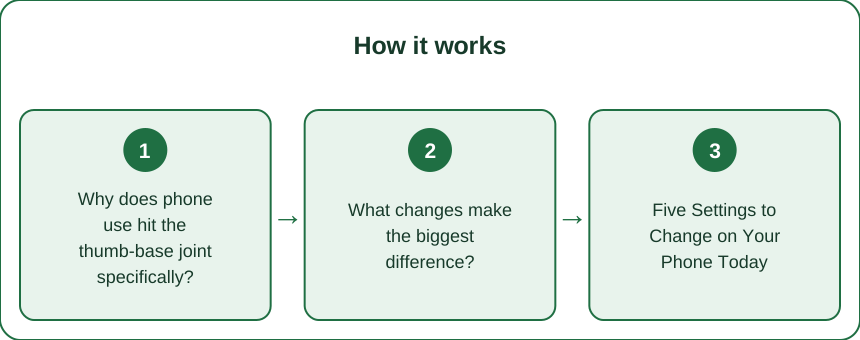
Why does phone use hit the thumb-base joint specifically?
The joint at the base of the thumb is one of the most common sites of osteoarthritis in the hand, particularly in women over 40, and it is the joint that does the most work in any pinch or grip.
Pinch grip multiplies force at that joint. The mechanics of the thumb mean the compressive load at the base joint is several times the force at the fingertips. A grip that feels light at the tip is not light at the base, which is why hand tasks that seem trivial can produce real symptoms.
One-handed phone use is a sustained pinch plus repeated extension. You clamp the phone between the thumb base and the fingers to hold it, then repeatedly stretch the thumb across the screen. That is a static load and a dynamic load at the same joint, simultaneously, for however long you are on the phone.
Screen size made it worse. Phones grew substantially over the last decade while hands did not. A larger device requires a wider span to hold securely and a longer thumb reach to operate, both of which increase the load at the base joint.
And the volume is the real story. Typical daily smartphone use runs to several hours across dozens of separate pickups. No one would voluntarily do three hours a day of pinch-grip exercise on an arthritic joint, but that is functionally what is happening.
The tell: aching at the base of the thumb near the wrist, worse in the evening, worse after a long scrolling session, sometimes with a grinding sensation or reduced grip strength on jar lids. If that pattern matches and it has persisted for weeks, it is worth a proper assessment.
What changes make the biggest difference?
Two hands, index fingers, always. Holding the phone in both hands and typing with the index fingers removes the pinch grip and the thumb extension in one move. It feels slow for about three days and then feels normal. This is the single highest-return change on the list.
Use voice dictation for anything longer than a few words. Dictation accuracy is genuinely good now and it eliminates the typing load entirely. Most people resist it out of habit rather than any real objection.
Rest the phone on a surface instead of holding it. A table, a lap cushion, a stand, the arm of a chair. Any support that takes the static grip load out of the hand converts a sustained pinch into a light tap.
Add a grip strap or a ring holder. A finger loop on the back means the phone hangs from a finger rather than being clamped between thumb and palm. For people who genuinely need one-handed use - on transport, walking - this is the best available option.
Consider a smaller phone at your next upgrade. This is the change people dismiss and later say made the most difference. A device you can hold securely without a wide span reduces the base load on every single pickup.
Raise it toward eye level. Looking down at a phone in your lap loads the neck and upper back, and people compensate by bracing the arm, which increases the grip tension. Bringing the phone up costs nothing and reduces tension through the whole chain.

Five Settings to Change on Your Phone Today
One: turn on voice dictation and put the microphone key where you can hit it. On most phones this is a keyboard setting. If dictation is two taps away you will use it; if it is buried you will not.
Two: increase the text size and reduce the screen zoom. Larger targets mean fewer mis-taps, and fewer mis-taps means fewer repeat corrections - which is where a surprising amount of the total thumb work happens.
Three: enable one-handed or reachability mode. Both major phone platforms have a setting that slides the top of the screen down within easy reach. It exists precisely because reaching the top corner of a large phone requires an awkward thumb stretch.
Four: turn on tap-to-wake and disable any gesture that requires a long swipe. Long edge-to-edge swipes are the worst individual movement for the thumb. Where a button alternative exists, use it.
Five: set a screen time reminder at 15-minute intervals during heavy-use periods. Not to shame you into using the phone less, but as a prompt to change grip, put it down for 30 seconds, and open and close the hand a few times. Load tolerance improves enormously with brief interruptions.
And one physical addition: a stylus. A cheap capacitive stylus held in a relaxed full-hand grip distributes the load across the whole hand instead of concentrating it at the thumb base. It looks slightly old-fashioned and it works extremely well.
What about strengthening and hand exercises?
Gentle hand exercise is generally recommended for hand osteoarthritis, and the evidence for range-of-motion and strengthening work is reasonably supportive for pain and function. But the specifics matter more here than in most areas.
Range of motion first, strength second. Simple movements - making a loose fist and opening fully, touching the thumb to each fingertip, spreading the fingers - done a few times a day, without resistance, maintain mobility and are unlikely to aggravate anything.
Be careful with grip strengtheners. Squeeze balls and spring grippers load the thumb base heavily and are frequently the thing that makes symptoms worse in people with base-of-thumb arthritis. If a hand therapist has prescribed one, follow that; if you bought one on a hunch, it may be working against you.
Putty and soft resistance are gentler options and allow graded loading in a way a fixed spring gripper does not.
A thumb splint can be genuinely useful, particularly worn at night or during high-load activities. Splints for base-of-thumb arthritis are a well-established conservative treatment, and a hand therapist can fit one properly - an off-the-shelf splint that immobilizes the wrong joint helps nobody.
Heat before activity, cold after if it flares. Warmth improves stiffness and makes movement more comfortable; cold reduces an acute flare. Neither is a cure and both are cheap.
And modify before you strengthen. The load reduction changes in the previous sections will do more for symptoms in the first month than any exercise program, because they reduce the input rather than trying to build tolerance to it.
This is general information, not medical advice. Persistent hand pain, visible joint changes, night pain, or loss of grip strength should be assessed by a doctor or hand therapist - hand osteoarthritis has real treatment options, and self-managing an undiagnosed problem is how people lose function they could have kept.
FAQ: Phone Use and Hand Arthritis, Answered
Can using a phone cause arthritis?
There is no good evidence that phone use causes osteoarthritis, which is driven mainly by age, genetics, previous injury, and joint mechanics. It can absolutely aggravate an existing arthritic joint and provoke tendon irritation, which is why symptoms often track with heavy use.
Is a bigger or smaller phone better for thumb arthritis?
Smaller, in almost every case. A narrower device requires less thumb span to hold and less reach to operate, which reduces load at the base joint on every use. A grip strap on a large phone is the next best option.
What is the best way to hold a phone with hand arthritis?
Two hands with the device resting on the fingers of both, typing with index fingers, or the phone supported on a surface or stand. The goal is to eliminate the sustained pinch grip that holds a phone one-handed.
Do hand exercises help arthritis or make it worse?
Gentle range-of-motion and graded strengthening work are generally recommended and supported by evidence for hand osteoarthritis. Aggressive grip strengtheners often aggravate base-of-thumb symptoms specifically, so get guidance from a hand therapist rather than guessing.
TL;DR:
- The thumb-base joint sees several times the applied force during a pinch, and one-handed phone use is a sustained pinch plus repeated thumb extension.
- Switch to a two-handed grip with index-finger typing, use voice dictation, and rest the phone on a surface whenever possible.
- Add a grip strap or ring, consider a smaller phone at upgrade time, and raise the screen toward eye level.
- Change five settings today: dictation, larger text, one-handed mode, fewer long swipes, and a 15-minute break prompt.
- Gentle range-of-motion work helps; spring grip strengtheners often aggravate base-of-thumb arthritis, and a properly fitted splint is worth asking about.
You are not going to stop using your phone, and you do not need to. You need to stop holding it in the one grip that loads the exact joint that hurts - and that is a three-day habit change, not a sacrifice.
Keep Reading
This article is for general informational purposes only and is not medical advice. Always consult a qualified health professional for guidance specific to you.