How to Keep Training Through a Flare Without Making It Worse
Quick Answer: During a flare, reduce load and range rather than stopping entirely - move the affected joint through comfortable range, keep training everything that is not flaring, and use the 24-hour rule: if pain is meaningfully worse the next morning, that was too much. Complete rest during a flare costs strength and often lengthens recovery, but so does training at your normal intensity. The target is the smallest amount of movement that maintains what you have.
The all-or-nothing pattern is the most common thing that turns a bad week into a bad month.

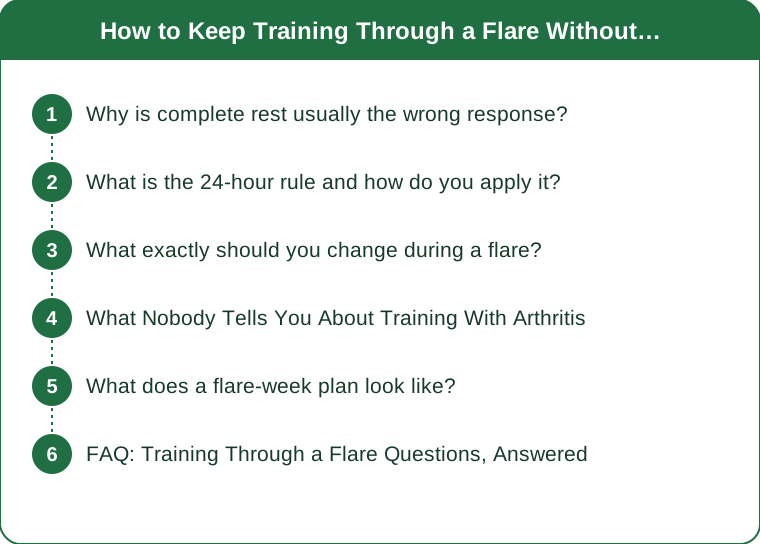
Why is complete rest usually the wrong response?
Because the costs of stopping compound faster than people expect, and they land in the places that make the next flare harder.
Strength drops measurably within a couple of weeks of inactivity, and strength around a joint is one of the main things distributing load away from it. Losing it means the joint takes more of the work when you resume.
Joints stiffen with immobility. Movement circulates synovial fluid, which is how cartilage receives nutrients. A joint held still for days is often stiffer and more painful when you come back to it than one that was moved gently throughout.
The confidence cost is real. A week off becomes two, and returning after a longer gap feels riskier, so the gap extends further. This is a very common pattern and it is worth naming.
What complete rest is genuinely appropriate for: an acutely hot, red, swollen joint, a suspected infection, a new injury, or a flare severe enough that ordinary daily movement is difficult. Those situations need a healthcare professional, not a training modification. This is general information, not medical advice - if you are unsure which situation you are in, ask.
What is the 24-hour rule and how do you apply it?
It is the most practical self-assessment tool available, and it removes most of the guesswork.
The rule: compare your pain and stiffness the morning after a session to the morning before it. Some increase during and immediately after activity is expected and fine. Meaningfully worse the following morning, or lasting more than about 24 hours, means the session was too much.
How to use it well:
- Rate pain and stiffness out of 10 each morning, before doing anything. Same time, before medication if that is consistent for you. Write it down.
- After a session, check the next morning’s number. Same or slightly better: repeat that session. Slightly worse: reduce by about 20 percent. Clearly worse: reduce substantially and rebuild.
- Do not judge from how you feel during the session. Movement often reduces stiffness in the moment, which can mask having done too much.
Why 24 hours specifically: short-term discomfort during and after exercise is normal and not a sign of harm. A response that persists into the next day is the point at which the load exceeded what the joint tolerated.
The rule turns an anxious, unanswerable question into a number you can check.
What exactly should you change during a flare?
Change the variables in this order. Most people jump straight to the last one and abandon the session entirely.
1. Reduce load first. Halve the weight, or move to bodyweight, or use a lighter band. This is the single most effective change and usually enough on its own.
2. Reduce range second. Work in the comfortable middle portion of the range rather than the ends. A partial-range squat to a chair maintains far more than no squat at all.
3. Reduce volume third. Two sets instead of four. Shorter sessions, potentially split across the day.
4. Change the movement fourth. Swap a loaded standing exercise for a seated or supported version, an impact exercise for a non-impact one, a barbell for a machine that controls the path.
5. Train around the joint fifth. A flaring wrist does not stop lower-body work. A flaring knee does not stop upper-body work. This is where most maintained strength comes from during a flare, and it is the most underused option.
6. Rest the joint only when the first five are exhausted - and even then, keep moving it gently through pain-free range several times a day.
Warmth before, and gentle movement, help most people start. Ten minutes of a warm shower or a heat pack before moving is a small thing with an outsized effect on how a flare session goes.

What Nobody Tells You About Training With Arthritis
Consistency matters more than intensity, by a wide margin. Three short sessions a week done through a flare beat two heavy sessions and then ten days off. The people who do best are almost always the ones who never fully stop, not the ones who train hardest.
Morning stiffness responds to movement the night before. A gentle evening mobility routine often improves the following morning more than anything you do on waking, which surprises people who assume the morning is when the work should happen.
Flares are not always caused by what you did. Sleep, stress, infection, and weather changes all get reported as triggers, and attributing every flare to your last session leads to unnecessary avoidance. Track them and look for patterns rather than assuming the cause.
Grip strength is a common hidden limiter. For upper-body work, hands often fail before the target muscles do, especially with hand or wrist involvement. Straps, thicker handles, and machine grips can let you keep training the muscle when the joint cannot hold the bar.
And the point that changes the most for people: you are allowed to have a session that is just movement. Ten minutes of gentle range-of-motion work on a bad day is a legitimate training session, counts as consistency, and keeps the habit and the joint alive. It does not need to be a workout to be worth doing.
What does a flare-week plan look like?
A concrete example, adjustable to which joints are involved.
Daily, every day of the flare (10 minutes): gentle range-of-motion for the affected joints, taken to comfortable end range and no further. Two or three times through, ideally spread across the day rather than done all at once. Warmth first.
Three times in the week (20 to 30 minutes): strength work for everything not flaring, at your normal load. If a knee is flaring, that means upper body and core. If a wrist is flaring, that means lower body. This is where you protect against strength loss.
Twice in the week (10 to 15 minutes): reduced-load work for the affected area. Partial range, light or no resistance, focus on control. Stop well short of any increase in pain.
Most days (10 to 20 minutes): easy walking or another low-impact activity you tolerate, if it does not aggravate the joint. Water-based work is often excellent during a flare, since buoyancy removes most joint load.
Rebuilding after the flare settles: increase one variable at a time, roughly 10 percent per week, load before range. Expect it to take a couple of weeks to return to where you were - and if you kept moving throughout, considerably less.
Any new joint, a hot swollen joint, fever, or a flare that does not settle in the pattern you are used to needs medical attention rather than a training plan. This is general information, not medical advice.
FAQ: Training Through a Flare Questions, Answered
Should I use heat or cold?
Many people find heat better for stiffness before movement and cold better for a hot, swollen joint afterwards. It varies between individuals and conditions, so it is worth testing what helps you rather than following a rule.
Is it safe to exercise while taking medication for pain?
Pain relief can mask feedback, which makes the 24-hour rule more important rather than less. Discuss timing with the professional managing your treatment, particularly with inflammatory conditions where flare management is part of the plan.
Which types of exercise are usually best tolerated?
Water-based work, cycling, and supported or seated resistance training are commonly well tolerated. High-impact and end-range loaded movements are usually the first to modify. The right answer depends on which joints are involved.
How do I tell a flare from a new injury?
A flare usually follows a pattern you recognise and affects joints already involved. A sudden new pain, a specific incident, a joint that gives way, or swelling in a previously unaffected joint all warrant assessment rather than self-management.
Will exercise make my arthritis worse over time?
Appropriately loaded exercise is generally recommended as part of managing most forms of arthritis, and inactivity carries its own well-documented costs. The specifics should come from your healthcare team, who can tailor it to your condition. This is general information, not medical advice.
TL;DR:
- Complete rest costs strength and stiffness quickly - the middle path is reduced, not stopped
- Use the 24-hour rule: worse the next morning means that session was too much
- Change load first, then range, then volume, then the movement itself - stopping is last
- Keep training everything that is not flaring; that is where maintained strength comes from
- A ten-minute movement session on a bad day is a legitimate session
The pattern that does the most damage is not overtraining and it is not resting. It is the swing between them - a heavy week, a flare, ten days off, a nervous return, another flare. Reducing rather than stopping keeps you on a much flatter line, and flat lines are what get you through a year. This is general information, not medical advice.
Keep Reading
This article is for general informational purposes only and is not medical advice. Always consult a qualified health professional for guidance specific to you.