The Morning Stiffness Routine: Unlocking Arthritic Joints Before Breakfast
Quick Answer: Morning joint stiffness happens because overnight stillness lets joint fluid thicken and inflammatory processes peak on a circadian schedule. A 3-4 minute in-bed mobility sequence followed by 3 minutes of standing movement while the kettle boils unlocks joints before the day starts making demands. Heat first on bad mornings. Your care team’s plan always leads.
Arthritic joints run on a cruel schedule. Worst at 7 a.m. Noticeably better by ten — which is, of course, after the morning has already demanded stairs, a jar lid and shoelaces.
The frustrating part is that by the time your body cooperates, the hardest tasks of the day are behind you.
This routine meets stiffness where it lives: in bed, before your feet hit the floor. (This is general information — your care team’s plan leads.)

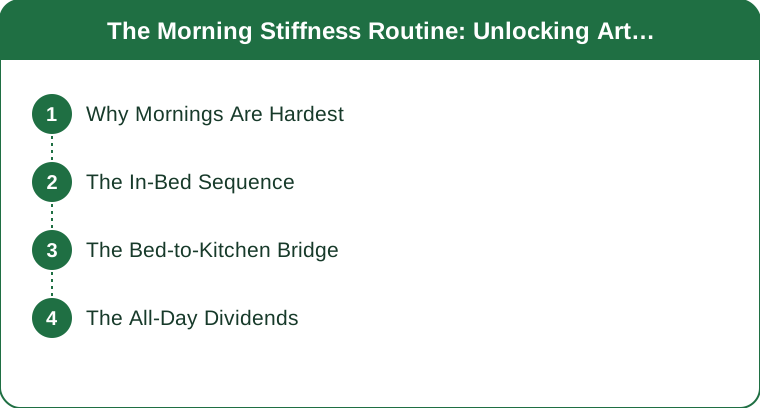
Why Are Arthritic Joints So Much Worse in the Morning?
Two things stack up overnight.
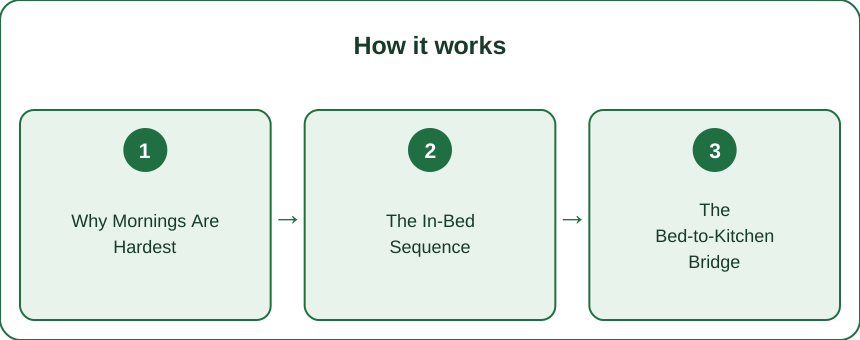
Joint fluid thickens when you stop moving. Synovial fluid — the lubricant inside your joints — is thixotropic, which is a technical way of saying it thins out when agitated and thickens when left alone. Like ketchup. Eight hours of stillness leaves it at its thickest, right when you’re asking a knee to carry you to the bathroom.
Inflammation follows a body clock. Many inflammatory arthritis types peak in the early morning hours, driven by the same circadian rhythms that govern hormones and body temperature. The “gel phenomenon” people describe isn’t imaginary and it isn’t random — it’s scheduled.
Here’s the reframe that changes how the morning feels: morning stiffness isn’t damage happening. It’s lubrication pending.
Movement is the shake the ketchup bottle needs. Gentle, early, and crucially — before the day starts making demands.
The In-Bed Sequence (3-4 Minutes)
Do this before your feet touch the floor. The bed is a warm-up bench; you’re already lying on it.
1. Ankle pumps and circles — 10 each direction, each foot. The furthest joints wake first and cost nothing.
2. Knee slides — 8 per side. Drag your heel up along the sheet toward your bottom, then slide it back down. Knees rehearse bending without carrying any weight.
3. Knee-to-chest hug — 20 seconds per side. Gentle, one leg at a time. Hips and lower back.
4. Pelvic tilts — 8 slow reps. Flatten your lower back into the mattress, then release. Small movement, useful signal.
5. Shoulder rolls and overhead reaches — 10 rolls, 5 reaches. Arms up over your head along the pillow if that’s comfortable.
6. Finger fists — 10 opens and closes per hand. Hands need the memo most, and they’re often the slowest to believe it. If they’re stubborn, run them under warm water at the sink and try again.
7. Neck turns — 5 each side. Slow, only as far as comfortable.
Nothing here should hurt. Stiff is expected. Sharp is not.

The Bed-to-Kitchen Bridge (3 Minutes)
Continue while the kettle runs. You’re standing anyway.
- Sink-supported mini squats — 8 reps. Hands on the counter, small range. The getting-up-from-a-chair muscles rehearse with a handrail.
- Heel raises — 10 reps. Counter for balance.
- Counter push-aways — 8 reps. Like a standing push-up against the worktop.
- Doorway lean stretch — 20 seconds. Forearms on the frame, gentle chest opening.
- Marching in place — 30 seconds while the tea steeps.
The heat assist: on bad mornings, take the warm shower before the routine rather than after. Heat thins the metaphorical ketchup faster, and the warm-water crowd has physiology on their side. Warm hands wrapped around a mug afterward doubles as finger therapy with a beverage attached — the most agreeable treatment in medicine.
What Nobody Tells You About Morning Stiffness
The duration is diagnostic information. How long morning stiffness lasts matters clinically — stiffness that persists well beyond an hour is a different signal from stiffness that clears in fifteen minutes. Track it, because it’s genuinely useful for your care team.
Stiffness rebuilds during the day if you sit still. The gel phenomenon isn’t only a morning event. Two hours at a desk recreates a smaller version of it, which is why the afternoon can feel like a second morning.
Cold mornings are objectively harder. Many people find symptoms track with temperature and weather changes. Warming the room, or warming yourself, before the routine is a practical adjustment, not a mental one.
Skipping the routine on bad days is the exact wrong instinct. Bad mornings should shrink the routine, never cancel it. Three ankle pumps beat zero ankle pumps by a genuinely meaningful margin.
Evening matters more than people expect. Tomorrow’s stiffness is partly tonight’s project. Gentle evening range-of-motion work and a warm bath before bed bank an easier morning.
How Do You Protect the Unlocked State All Day?
Getting the joints moving at 7 a.m. is only worth it if the day doesn’t undo it by ten.
- Movement snacks, hourly. Two minutes of standing and strolling every hour. Set a reminder if needed. This is the single highest-value habit in the whole article, and the one most people skip because it feels too small to matter.
- Break up long sitting deliberately. Stand during phone calls, walk to a further kettle, take the long route to anything.
- Prep the evening. Gentle range-of-motion before bed, a warm bath, and comfortable sleepwear that doesn’t bind at the knees or hips.
- Dress for movement. A soft, non-restrictive waistband and easy-on layers remove small daily friction — a pair of high waist leggings with a wide flat waistband is far kinder to stiff hands at 7 a.m. than a button and zip.
- Track your mornings. A simple note — how long stiffness lasted, how bad — for a few weeks.
When to see a professional: morning stiffness that improves over weeks with this routine is the routine working. Stiffness that’s worsening, lasting longer, spreading to new joints, or arriving with swelling, warmth, redness or fever is data for your doctor, not a reason to stretch harder. New or sudden joint symptoms always warrant a proper assessment, and any exercise plan should fit within what your rheumatologist or physical therapist has advised.
FAQ
How long should morning stiffness last with arthritis?
It varies by type and by person, and the duration itself is clinically meaningful — which is exactly why it’s worth tracking and reporting. Stiffness that lasts substantially longer than usual for you, or that’s steadily lengthening week over week, is worth raising with your doctor rather than managing alone.
Should I use heat or ice for morning stiffness?
Heat is generally the better fit for stiffness — warm showers, heated pads, warm water for hands — because it helps tissues move more easily. Ice tends to be more useful for an acutely swollen, hot, inflamed joint. Many people use both at different times, and your care team can tell you which applies to your situation.
Is it safe to exercise with arthritic joints?
Appropriate movement is generally recommended rather than avoided, and gentle range-of-motion work like this sequence is usually well tolerated. What matters is matching the type and intensity to your condition and current status — get your specific plan from a physical therapist or rheumatologist, especially during a flare.
TL;DR
- Morning stiffness is lubrication pending, not damage — joint fluid thickens overnight and inflammation peaks on a body clock.
- Move before the day makes demands. The in-bed sequence takes 3-4 minutes.
- Ankles, knees, hips, shoulders, hands — in that order, starting furthest out.
- Add 3 minutes standing while the kettle boils; use heat before the routine on bad mornings.
- Movement snacks hourly protect the morning’s work from being undone by stillness.
- Bad mornings shrink the routine, never skip it. Worsening mornings are doctor data.
Keep Reading
This article is for general informational purposes only and is not medical advice. Always consult a qualified health professional for guidance specific to you.