Arthritis-Friendly Strength Tools: Grips, Bands and Kind Equipment
Quick Answer: Arthritis-friendly strength tools are the ones that remove the grip problem: foam grip sleeves that slide onto any dumbbell handle, thicker-handled weights, wrist-strap assists, loop bands worn around the forearms, and machines that push rather than grip. Bands are especially good because resistance is lightest at the start of the range where joints are typically sorest.
Strength training is first-line care for arthritis. Every guideline says so.
What nobody mentions is that standard gym equipment quietly assumes pain-free hands and forgiving joints. A thin dumbbell handle concentrates load onto exactly the small finger joints that hurt. (Your care team’s guidance leads — this is general information.)

How Do You Lift When Your Hands Hurt?
The grip is usually the limiting factor long before the muscle is. Four fixes, cheapest first:
1. Foam grip sleeves. Around $10–15. These slide onto any dumbbell, barbell or machine handle and increase the diameter dramatically. Thicker handles distribute pressure across the whole hand instead of concentrating it on small joints. Coffee-money cheap and genuinely transformative — this is the first thing to try.
2. Thicker-handled dumbbells. Some manufacturers make them; the grip sleeves get you most of the way for a fraction of the cost.
3. Wrist strap assists. $12–20. Straps loop around the wrist and the handle, letting your arm lift what your fingers can’t hold. Common in powerlifting, ideal for arthritic hands, and they remove grip from the equation entirely on rows and carries.
4. Machines that push rather than grip. A leg press asks nothing of your knuckles. Chest press machines, leg curls, and cable machines with strap attachments all let you train hard while your hands do very little.
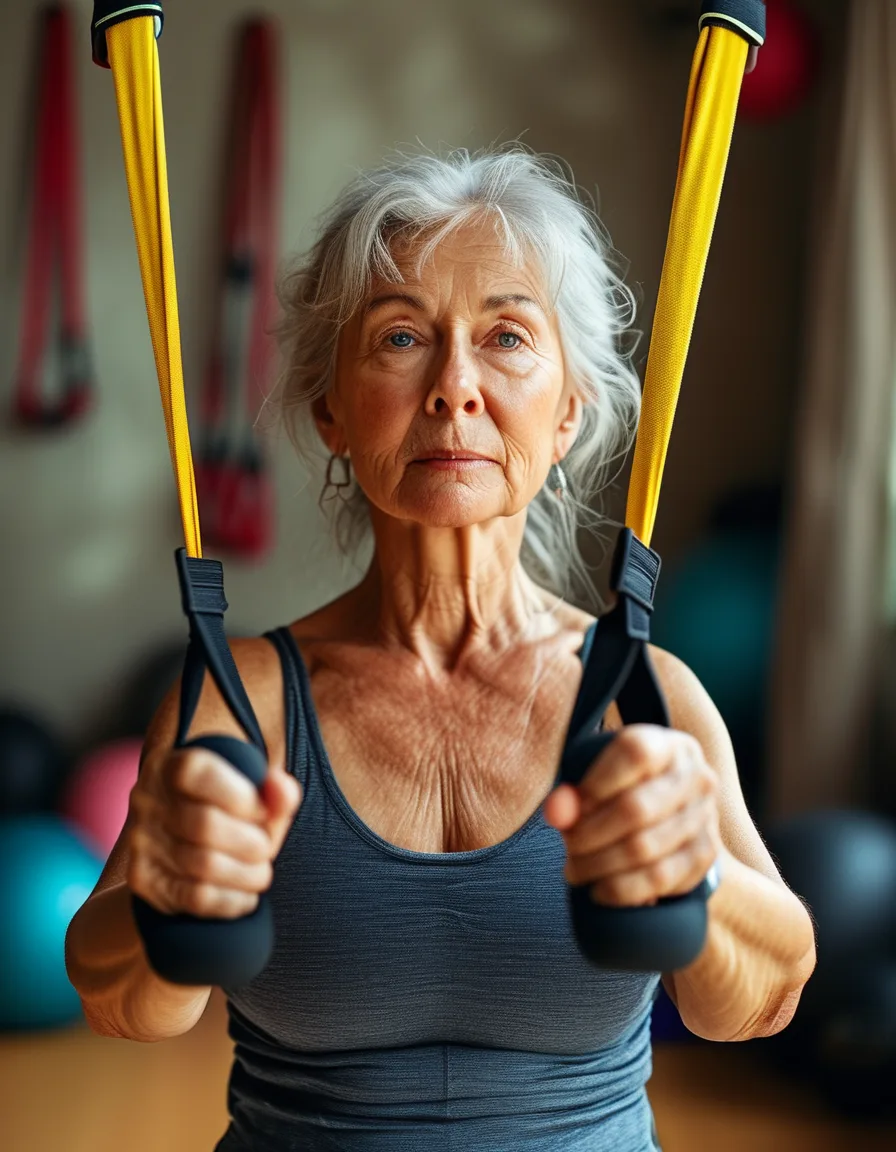
5. Loop bands worn around the forearms. Resistance without a single clenched finger. For upper body work, this is often the most comfortable option available.
Why Are Resistance Bands So Well Suited to Arthritis?
Bands have properties that happen to fit arthritic joints almost perfectly.
Resistance rises through the range. A band is lightest at the stretched, often-sorest start of a movement and heaviest where the joint is strongest and best supported. That’s an accidentally ideal loading curve — you’d have to design it deliberately with a machine.
Angle freedom. You can work exactly the pain-free arc you have available. A barbell demands its own geometry; a band adapts to yours.
No momentum, nothing to drop. No clanking, no jarring deceleration, and no plate landing on a foot on a bad day.
Home-friendly. Flare days can still train in the living room. Consistency is what arthritis management rewards most, and bands remove the “I couldn’t get to the gym” failure mode.
The starter kit: a light-medium-heavy loop set, a long band with padded handles, and a door anchor. That’s it.
Machines or Free Weights — Which Is Better?
The honest comparison for arthritic lifters:
Machines win the start. Guided paths protect joints on wobbly days, seat adjustments accommodate different bodies, and a weight-stack pin beats plate-loading with sore hands. If you’re beginning, machines are the friendlier entry.
Free weights win the function. Real-life carrying, reaching and lifting are free-weight patterns. Graduate to them where joints allow, using the grip aids above.
The both-answer wins overall. Machine legs + band uppers + a dumbbell carry is a complete, kind program. There’s no prize for purity here.
The one universal rule: whatever the tool, load ramps gradually. Arthritic tissue adapts beautifully and slowly, in that order. Add roughly 5–10% every couple of weeks, not every session.
What Nobody Tells You
Every standing exercise has a seated version. Seated rows, seated presses, seated band work, chair-supported leg extensions. The chair-based library is far larger than most people realize, and it’s not a lesser form of training.
Water is equipment. Pool-based strength work is arthritis royalty — you get drag resistance with buoyancy’s discount on joint load. For anyone in a flare, it’s often the only place a full range of motion is available.
Heat is a training tool. A heat pack for five minutes before a session prepares stiff joints for work. Five warm minutes reliably buys thirty usable training minutes.
Shoes are knee equipment. Cushioned, supportive footwear changes what your knees experience during every standing exercise. The training happens on top of them.
Grip strength itself is trainable. Gentle putty or a soft stress ball, done consistently, often improves hand function over months — which then makes everything else easier. Check with your care team on what’s appropriate for your specific condition.
What Does a Kind Program Look Like?
Twice a week, roughly 25 minutes:
- Legs: leg press or sit-to-stands, 2–3 × 8–10
- Push: band chest press or a machine press, 2–3 × 10
- Pull: band row or machine row with straps, 2–3 × 10
- Hips: banded lateral walks or glute bridges, 2 × 12
- Carry: a dumbbell carry with grip sleeves, 2 × 30 seconds
Work within a pain-free range. Mild discomfort during and shortly after is normal; sharp pain or new joint swelling means stop that exercise. See the broader arthritis exercise guide for how this fits with the rest of your routine.
FAQ
What’s the cheapest arthritis-friendly equipment upgrade?
Foam grip sleeves, at around $10–15. They slide onto anything and immediately reduce the load concentrated on small hand joints. Start there before buying anything else.
Should you strength train during a flare?
Usually scaled down rather than stopped — band work, water exercise, or gentle range-of-motion. If a joint is hot, red and visibly swollen, rest that joint and train around it. Complete rest during flares tends to extend the recovery.
Are wrist straps cheating?
No. They shift the limiting factor from your fingers to your target muscles, which is exactly the point. Your back doesn’t know or care why your grip held.
When should you see a professional?
Talk to your care team before starting a program, and see them for any joint that’s hot, red, swollen, locking or giving way. A physiotherapist familiar with arthritis is genuinely worth one or two sessions to set starting loads and check which tools suit your specific joints.
TL;DR:
- Grip is usually the limiting factor — fix that first with foam sleeves (~$10–15) or wrist straps.
- Machines that push rather than grip (leg press, chest press) ask nothing of the hands.
- Bands suit arthritic joints unusually well: lightest at the sore start of the range, no momentum, no drop risk.
- Starter kit: light-medium-heavy loop set, long band with padded handles, door anchor.
- Machines to start, free weights for function, a mix for the best program.
- Ramp load gradually — roughly 5–10% every couple of weeks.
- Seated versions, warm water, pre-session heat, and supportive shoes all count as equipment. Care team’s guidance leads.
Keep Reading
This article is for general informational purposes only and is not medical advice. Always consult a qualified health professional for guidance specific to you.